Description:
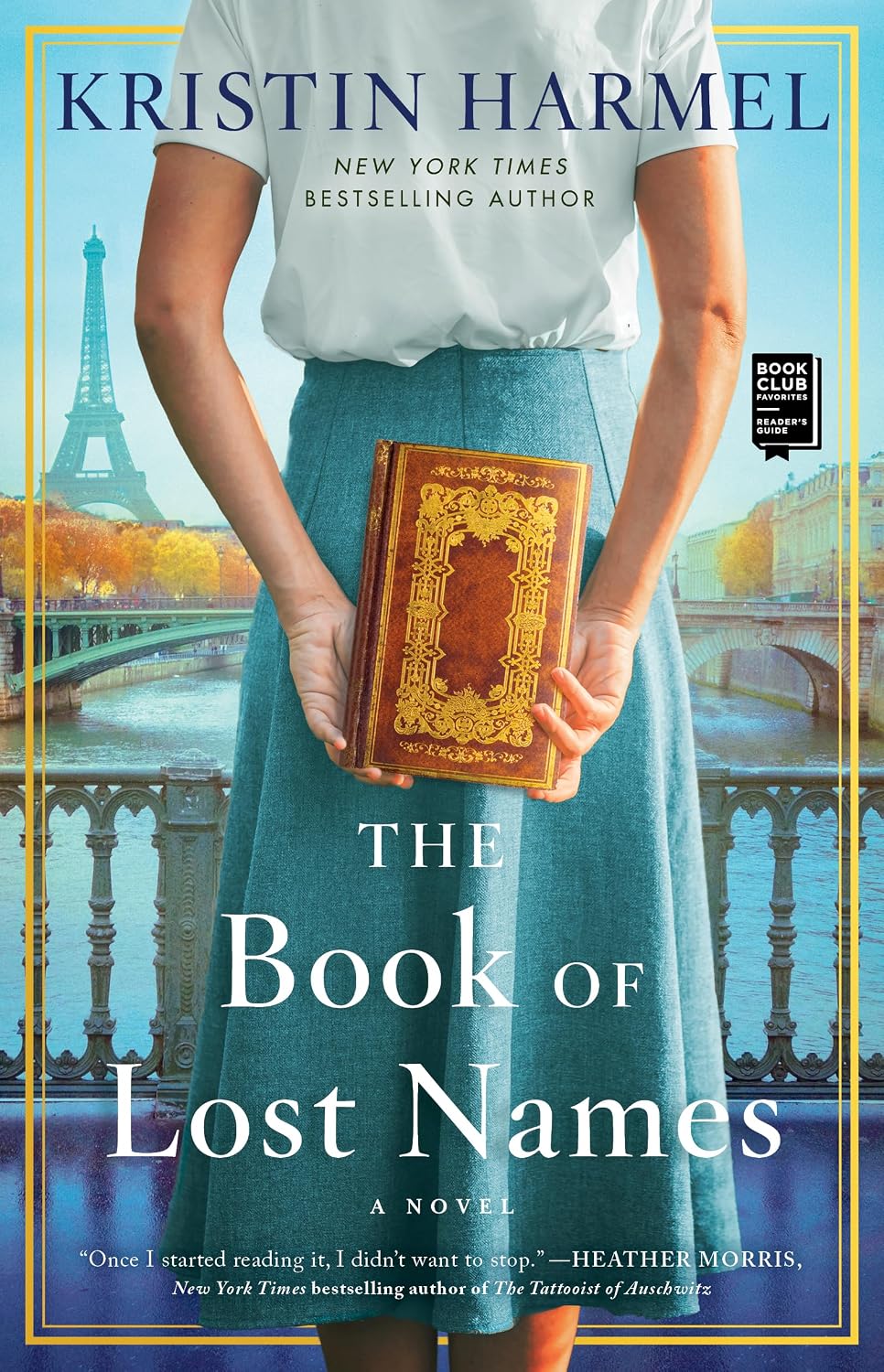
Inspired by an astonishing true story from World War II, a young woman with a talent for forgery helps hundreds of Jewish children flee the Nazis in this “sweeping and magnificent” (Fiona Davis, bestselling author of The Lions of Fifth Avenue) historical novel from the #1 international bestselling author of The Winemaker’s Wife.
Eva Traube Abrams, a semi-retired librarian in Florida, is shelving books when her eyes lock on a photograph in the New York Times. She freezes; it’s an image of a book she hasn’t seen in more than sixty years—a book she recognizes as The Book of Lost Names.
The accompanying article discusses the looting of libraries by the Nazis across Europe during World War II—an experience Eva remembers well—and the search to reunite people with the texts taken from them so long ago. The book in the photograph, an eighteenth-century religious text thought to have been taken from France in the waning days of the war, is one of the most fascinating cases. Now housed in Berlin’s Zentral- und Landesbibliothek library, it appears to contain some sort of code, but researchers don’t know where it came from—or what the code means. Only Eva holds the answer, but does she have the strength to revisit old memories?
As a graduate student in 1942, Eva was forced to flee Paris and find refuge in a small mountain town in the Free Zone, where she began forging identity documents for Jewish children fleeing to neutral Switzerland. But erasing people comes with a price, and along with a mysterious, handsome forger named Rémy, Eva decides she must find a way to preserve the real names of the children who are too young to remember who they really are. The records they keep in The Book of Lost Names will become even more vital when the resistance cell they work for is betrayed and Rémy disappears.
An engaging and evocative novel reminiscent of The Lost Girls of Paris and The Alice Network, The Book of Lost Names is a testament to the resilience of the human spirit and the power of bravery and love in the face of evil.
Review
"If you love historical fiction about World War II, you will enjoy this story of Eva, a young woman who during the war helps Jewish kids escape France by forging documents." ― –St. Louis Post-Dispatch
“With meticulous research and an assured hand, Kristin Harmel once again spotlights French Resistance figures of the Second World War, unique heroes whose bravery and immeasurable sacrifices are too often lost to history. THE BOOK OF LOST NAMES is a fascinating, heartrending page-turner that, like the real-life forgers who inspired the novel, should never be forgotten. A riveting historical tale that I devoured in a single sitting.” -- Kristina McMorris, New York Times bestselling author of Sold on a Monday
“Harmel brilliantly imagines the life of a young Polish-French Jewish woman during the depths of WWII...Harmel movingly illustrates Eva’s courage to risk her own life for others, and all of the characters are portrayed with realistic compassion. This thoughtful work will touch readers with its testament to the endurance of hope." ― Publishers Weekly (starred review)
"Not since “The Nightingale” have I finished a book and been so choked with emotion. Harmel was inspired by the true story of French citizens who fought against evil during WWII with courage and conviction. She shines a brilliant light on those who had their identities erased and lives destroyed, on a country and its people torn apart, and young women like Eva, who risked their lives with everyday acts of epic heroism. Sweeping and magnificent."
-- Fiona Davis, national bestselling author of The Lions of Fifth Avenue
"A heart-stopping tale of survival and heroism centered on a female forger who risks everything to help Jewish children escape Nazi-occupied France." ― People (20 Best Books to Read this Summer)
“Harmel’s previous historical novels, including The Winemaker's Wife (2019), illuminate heartbreakingly real but forgotten stories from World War II, blended with a dash of suspense and romance, and this does the same. Recommend to fans of romantic historical fiction, including All the Ways We Said Goodbye (2020)." ― Booklist
“A celebration of the power of books to give hope and healing, this lovely tale offers hope in troubled times.” ― –The Toronto Star
“With exceptional skill, Kristin Harmel constructs The Winemaker's Wife between the past and the present, giving equal weight and importance to both, all the while weaving a tale full of secrets and betrayals that puts to the test mankind's strength, fragility and vileness. Once you start reading this moving novel, you will not be able to put it down until you reach the last page.” -- Armando Lucas Correa, bestselling author of The German Girl, on THE WINEMAKER'S WIFE
"Harmel's engrossing latest reminds us that love, like resistance, begins with courage." ― People on THE ROOM ON RUE AMELIE
"This book of historical fiction is also a surprising story of love, courage, and the resiliency of the human spirit....[Harmel] manages to draw her audience in, even to the point of unexpected tears at the story’s end.." ― Jewish Book Council on THE ROOM ON RUE AMELIE
“Kristin Harmel writes with such insight and heart that her characters will stay with you long after you’ve finished her books.”
-- New York Times bestselling author Emily Giffin on THE SWEETNESS OF FORGETTING
About the Author
Excerpt. © Reprinted by permission. All rights reserved.
May 2005
It’s a Saturday morning, and I’m midway through my shift at the Winter Park Public Library when I see it.
The book I last laid eyes on more than six decades ago.
The book I believed had vanished forever.
The book that meant everything to me.
It’s staring out at me from a photograph in the New York Times, which someone has left open on the returns desk. The world goes silent as I reach for the newspaper, my hand trembling nearly as much as it did the last time I held the book. “It can’t be,” I whisper.
I gaze at the picture. A man in his seventies looks back at me, his snowy hair sparse and wispy, his eyes froglike behind bulbous glasses.
“Sixty Years After End of World War II, German Librarian Seeks to Reunite Looted Books with Rightful Owners,” declares the headline, and I want to cry out to the man in the image that I am the rightful owner of the book he’s holding, the faded leather-bound volume with the peeling bottom right corner and the gilded spine bearing the title Epitres et Evangiles. It belongs to me—and to Rémy, a man who died long ago, a man I vowed after the war to think of no more.
But he’s been in my thoughts this week anyhow, despite my best efforts. Tomorrow, the eighth of May, the world will celebrate the sixtieth anniversary of Victory in Europe Day. It’s impossible, with all the young newscasters speaking solemnly of the war as if they could conceivably understand it, not to think of Rémy, not to think of the time we spent together then, not to think of the people we saved and the way it all ended. Though my son tells me I’m blessed to have such a sharp mind in my old age, like many blessings this one is mixed.
Most days, I just long to forget.
I blink away the uninvited thoughts of Rémy and return my attention to the article. The man in the photo is Otto Kühn, a librarian from the Zentral- und Landesbibliothek in Berlin, who has made it his life’s mission to return books looted by the Nazis. There are apparently more than a million such books in his library’s collection alone, but the one he’s holding in the photo—my book—is the one he says keeps him up at night.
“This religious text,” Kühn has told the reporter, “is my favorite among the many mysteries that occupy our shelves. Published in Paris in 1732, it’s a very rare book, but that’s not what makes it extraordinary. It is unique because within it, we find an intriguing puzzle: some sort of code. To whom did it belong? What does the code mean? How did the Germans come to possess it during the war? These are the questions that haunt me.”
I feel tears in my eyes, tears that have no place there. I wipe them away, angry at myself for still being so emotional after all these years. “How nice it must be,” I say softly to Kühn’s picture, “to be haunted by questions rather than ghosts.”
“Um, Mrs. Abrams? Are you talking to that newspaper?”
I’m jolted out of the fog of my memory by the voice of Jenny Fish, the library’s assistant manager. She’s the type who complains about everything—and who seems to enjoy suggesting at every opportunity that since I’m eighty-six, I might want to think about retiring soon. She is always eyeing me suspiciously, as if she simply cannot believe that at my age, I’d still want to work here.
She doesn’t understand what it means to love books so passionately that you would die without them, that you would simply stop breathing, stop existing. It is quite beyond me, in fact, why she became a librarian in the first place.
“Yes, Jenny, indeed I am,” I reply, without looking up.
“Yes, well, you probably shouldn’t be doing that in front of library guests.” She says it without a trace of irony. “They might think you’re senile.” She does not have a sense of humor.
“Thank you, Jenny. Your advice is always so very helpful.”
She nods solemnly. It is also apparently beyond her comprehension that someone who looks like me—small, white-haired, grandmotherly—is capable of sarcasm.
Today, though, I have no time for her. All I can think about is the book. The book that held so many secrets. The book that was taken from me before I could learn whether it contained the one answer I so desperately needed.
And now, a mere plane flight away, there’s a man who holds the key to unlocking everything.
“Do I dare?” I murmur to the photo of Otto Kühn. I respond to my own question before doubt can creep in. “I must. I owe it to the children.”
“Mrs. Abrams?” It’s Jenny again, addressing me by my surname, though I’ve told her a thousand times to call me Eva, just as she addresses the younger librarians by their given names. But alas, I am nothing to her but an old lady. One’s reward for marching through the decades is a gradual process of erasure.
“Yes, Jenny?” I finally look up at her.
“Do you need to go home?” I suspect she says it with the expectation that I’ll decline. She’s smirking a bit, certain that she has asserted her superiority. “Perhaps gather yourself?”
So it gives me great pleasure to look her right in the eye, smile, and say, “Yes, Jenny, thank you ever so much. I think I’ll do just that.”
I grab the newspaper and go.
As soon as I arrive at my house—a cozy bungalow just a five-minute walk from the library—I log on to my computer.
Yes, I have a computer. And yes, I know how to use it. My son, Ben, has a bad habit of pronouncing computer terms slowly in my presence—in-ter-net and e-mail-ing—as if the whole concept of technology might be too much for me. I suppose I can’t blame him, not entirely. By the time Ben was born, the war was eight years past, and I’d left France—and the person I used to be—far behind. Ben knew me only as a librarian and housewife who sometimes stumbled over her English.
Somewhere along the way, he got the mistaken idea that I am a simple person. What would he say if he knew the truth?
It’s my fault for never telling him, for failing to correct the error. But when you grow comfortable hiding within a protective shell, it’s harder than one might expect to stand up and say, “Actually, folks, this is who I am.”
Perhaps I also feared that Ben’s father, my husband, Louis, would leave me if he realized I was something other than the person I wanted him to see. He left me anyhow—pancreatic cancer a decade ago—and though I’ve missed his companionship, I’ve also had the strange realization that I probably could have done without him much sooner.
I go to the website for Delta—habit, I suppose, since Louis traveled often for business and was part of the airline’s frequent-flier program. The prices are exorbitant, but I have plenty stashed away in savings. It’s just before noon, and there’s a flight that leaves three hours from now, and another leaving at 9:35 tonight, connecting in Amsterdam tomorrow, and landing in Berlin at 3:40 p.m. I click immediately and book the latter. There is something poetic about knowing I will arrive in Berlin sixty years to the day after the Germans signed an unconditional surrender to the Allies in that very city.
A shiver runs through me, and I don’t know whether it’s fear or excitement.
I must pack, but before that, I’ll need to call Ben. He won’t understand, but perhaps it’s finally time for him to learn that his mother isn’t the person he always believed her to be.
Details:
Visit the Gallery Books Store
The Book of Lost Names
BHD910
Quantity:
Order today to get by 7-14 business days
Delivery fee of BHD 2. Free for orders above BHD 20.
 Imported From: United States
At BOLO, we work hard to ensure the products you receive are new, genuine, and sourced from reputable suppliers.
Every product in the BOLO catalogue is sourced through our Verified Global Supply Network of verified sellers, authorized distributors or directly from the manufacturer.
Each product undergoes thorough inspection and verification at our consolidation and fulfilment centers to ensure it meets our strict authenticity and quality standards before being shipped and delivered to you.
If you ever have concerns regarding the authenticity of a product purchased from us, please contact Bolo Support. We will review your inquiry promptly and, if necessary, provide documentation verifying authenticity or offer a suitable resolution.
Your trust is our top priority, and we are committed to maintaining transparency and integrity in every transaction.
While we strive to display accurate information, variations in packaging, labeling, instructions, or formulation may occasionally occur due to regional differences or supplier updates. For detailed or manufacturer-specific information, please contact the brand directly or reach out to BOLO Support for assistance.
Unless otherwise stated, all prices displayed on the product page include applicable taxes and import duties.
BOLO operates in accordance with the laws and regulations of Bahrain. Any items found to be restricted or prohibited for sale within the Bahrain will be cancelled prior to shipment. We take proactive measures to ensure that only products permitted for sale in Bahrain are listed on our website.
All items are shipped by air, and any products classified as “Dangerous Goods (DG)” under IATA regulations will be removed from the order and cancelled.
All orders are processed manually, and we make every effort to process them promptly once confirmed. Products cancelled due to the above reasons will be permanently removed from listings across the website.


Similar suggestions by Bolo
More from this brand
Similar items from “World War II & Holocaust”
Share with
Or share with link
https://www.bolo.bh/products/U198213190K
Visit the Gallery Books Store
The Book of Lost Names
BHD910
Quantity:
Order today to get by 7-14 business days
Delivery fee of BHD 2. Free for orders above BHD 20.
Imported From: United States
At BOLO, we work hard to ensure the products you receive are new, genuine, and sourced from reputable suppliers.
Every product in the BOLO catalogue is sourced through our Verified Global Supply Network of verified sellers, authorized distributors or directly from the manufacturer.
Each product undergoes thorough inspection and verification at our consolidation and fulfilment centers to ensure it meets our strict authenticity and quality standards before being shipped and delivered to you.
If you ever have concerns regarding the authenticity of a product purchased from us, please contact Bolo Support. We will review your inquiry promptly and, if necessary, provide documentation verifying authenticity or offer a suitable resolution.
Your trust is our top priority, and we are committed to maintaining transparency and integrity in every transaction.
While we strive to display accurate information, variations in packaging, labeling, instructions, or formulation may occasionally occur due to regional differences or supplier updates. For detailed or manufacturer-specific information, please contact the brand directly or reach out to BOLO Support for assistance.
Unless otherwise stated, all prices displayed on the product page include applicable taxes and import duties.
BOLO operates in accordance with the laws and regulations of Bahrain. Any items found to be restricted or prohibited for sale within the Bahrain will be cancelled prior to shipment. We take proactive measures to ensure that only products permitted for sale in Bahrain are listed on our website.
All items are shipped by air, and any products classified as “Dangerous Goods (DG)” under IATA regulations will be removed from the order and cancelled.
All orders are processed manually, and we make every effort to process them promptly once confirmed. Products cancelled due to the above reasons will be permanently removed from listings across the website.
Description:
Inspired by an astonishing true story from World War II, a young woman with a talent for forgery helps hundreds of Jewish children flee the Nazis in this “sweeping and magnificent” (Fiona Davis, bestselling author of The Lions of Fifth Avenue) historical novel from the #1 international bestselling author of The Winemaker’s Wife.
Eva Traube Abrams, a semi-retired librarian in Florida, is shelving books when her eyes lock on a photograph in the New York Times. She freezes; it’s an image of a book she hasn’t seen in more than sixty years—a book she recognizes as The Book of Lost Names.
The accompanying article discusses the looting of libraries by the Nazis across Europe during World War II—an experience Eva remembers well—and the search to reunite people with the texts taken from them so long ago. The book in the photograph, an eighteenth-century religious text thought to have been taken from France in the waning days of the war, is one of the most fascinating cases. Now housed in Berlin’s Zentral- und Landesbibliothek library, it appears to contain some sort of code, but researchers don’t know where it came from—or what the code means. Only Eva holds the answer, but does she have the strength to revisit old memories?
As a graduate student in 1942, Eva was forced to flee Paris and find refuge in a small mountain town in the Free Zone, where she began forging identity documents for Jewish children fleeing to neutral Switzerland. But erasing people comes with a price, and along with a mysterious, handsome forger named Rémy, Eva decides she must find a way to preserve the real names of the children who are too young to remember who they really are. The records they keep in The Book of Lost Names will become even more vital when the resistance cell they work for is betrayed and Rémy disappears.
An engaging and evocative novel reminiscent of The Lost Girls of Paris and The Alice Network, The Book of Lost Names is a testament to the resilience of the human spirit and the power of bravery and love in the face of evil.
Review
"If you love historical fiction about World War II, you will enjoy this story of Eva, a young woman who during the war helps Jewish kids escape France by forging documents." ― –St. Louis Post-Dispatch
“With meticulous research and an assured hand, Kristin Harmel once again spotlights French Resistance figures of the Second World War, unique heroes whose bravery and immeasurable sacrifices are too often lost to history. THE BOOK OF LOST NAMES is a fascinating, heartrending page-turner that, like the real-life forgers who inspired the novel, should never be forgotten. A riveting historical tale that I devoured in a single sitting.” -- Kristina McMorris, New York Times bestselling author of Sold on a Monday
“Harmel brilliantly imagines the life of a young Polish-French Jewish woman during the depths of WWII...Harmel movingly illustrates Eva’s courage to risk her own life for others, and all of the characters are portrayed with realistic compassion. This thoughtful work will touch readers with its testament to the endurance of hope." ― Publishers Weekly (starred review)
"Not since “The Nightingale” have I finished a book and been so choked with emotion. Harmel was inspired by the true story of French citizens who fought against evil during WWII with courage and conviction. She shines a brilliant light on those who had their identities erased and lives destroyed, on a country and its people torn apart, and young women like Eva, who risked their lives with everyday acts of epic heroism. Sweeping and magnificent."
-- Fiona Davis, national bestselling author of The Lions of Fifth Avenue
"A heart-stopping tale of survival and heroism centered on a female forger who risks everything to help Jewish children escape Nazi-occupied France." ― People (20 Best Books to Read this Summer)
“Harmel’s previous historical novels, including The Winemaker's Wife (2019), illuminate heartbreakingly real but forgotten stories from World War II, blended with a dash of suspense and romance, and this does the same. Recommend to fans of romantic historical fiction, including All the Ways We Said Goodbye (2020)." ― Booklist
“A celebration of the power of books to give hope and healing, this lovely tale offers hope in troubled times.” ― –The Toronto Star
“With exceptional skill, Kristin Harmel constructs The Winemaker's Wife between the past and the present, giving equal weight and importance to both, all the while weaving a tale full of secrets and betrayals that puts to the test mankind's strength, fragility and vileness. Once you start reading this moving novel, you will not be able to put it down until you reach the last page.” -- Armando Lucas Correa, bestselling author of The German Girl, on THE WINEMAKER'S WIFE
"Harmel's engrossing latest reminds us that love, like resistance, begins with courage." ― People on THE ROOM ON RUE AMELIE
"This book of historical fiction is also a surprising story of love, courage, and the resiliency of the human spirit....[Harmel] manages to draw her audience in, even to the point of unexpected tears at the story’s end.." ― Jewish Book Council on THE ROOM ON RUE AMELIE
“Kristin Harmel writes with such insight and heart that her characters will stay with you long after you’ve finished her books.”
-- New York Times bestselling author Emily Giffin on THE SWEETNESS OF FORGETTING
About the Author
Excerpt. © Reprinted by permission. All rights reserved.
May 2005
It’s a Saturday morning, and I’m midway through my shift at the Winter Park Public Library when I see it.
The book I last laid eyes on more than six decades ago.
The book I believed had vanished forever.
The book that meant everything to me.
It’s staring out at me from a photograph in the New York Times, which someone has left open on the returns desk. The world goes silent as I reach for the newspaper, my hand trembling nearly as much as it did the last time I held the book. “It can’t be,” I whisper.
I gaze at the picture. A man in his seventies looks back at me, his snowy hair sparse and wispy, his eyes froglike behind bulbous glasses.
“Sixty Years After End of World War II, German Librarian Seeks to Reunite Looted Books with Rightful Owners,” declares the headline, and I want to cry out to the man in the image that I am the rightful owner of the book he’s holding, the faded leather-bound volume with the peeling bottom right corner and the gilded spine bearing the title Epitres et Evangiles. It belongs to me—and to Rémy, a man who died long ago, a man I vowed after the war to think of no more.
But he’s been in my thoughts this week anyhow, despite my best efforts. Tomorrow, the eighth of May, the world will celebrate the sixtieth anniversary of Victory in Europe Day. It’s impossible, with all the young newscasters speaking solemnly of the war as if they could conceivably understand it, not to think of Rémy, not to think of the time we spent together then, not to think of the people we saved and the way it all ended. Though my son tells me I’m blessed to have such a sharp mind in my old age, like many blessings this one is mixed.
Most days, I just long to forget.
I blink away the uninvited thoughts of Rémy and return my attention to the article. The man in the photo is Otto Kühn, a librarian from the Zentral- und Landesbibliothek in Berlin, who has made it his life’s mission to return books looted by the Nazis. There are apparently more than a million such books in his library’s collection alone, but the one he’s holding in the photo—my book—is the one he says keeps him up at night.
“This religious text,” Kühn has told the reporter, “is my favorite among the many mysteries that occupy our shelves. Published in Paris in 1732, it’s a very rare book, but that’s not what makes it extraordinary. It is unique because within it, we find an intriguing puzzle: some sort of code. To whom did it belong? What does the code mean? How did the Germans come to possess it during the war? These are the questions that haunt me.”
I feel tears in my eyes, tears that have no place there. I wipe them away, angry at myself for still being so emotional after all these years. “How nice it must be,” I say softly to Kühn’s picture, “to be haunted by questions rather than ghosts.”
“Um, Mrs. Abrams? Are you talking to that newspaper?”
I’m jolted out of the fog of my memory by the voice of Jenny Fish, the library’s assistant manager. She’s the type who complains about everything—and who seems to enjoy suggesting at every opportunity that since I’m eighty-six, I might want to think about retiring soon. She is always eyeing me suspiciously, as if she simply cannot believe that at my age, I’d still want to work here.
She doesn’t understand what it means to love books so passionately that you would die without them, that you would simply stop breathing, stop existing. It is quite beyond me, in fact, why she became a librarian in the first place.
“Yes, Jenny, indeed I am,” I reply, without looking up.
“Yes, well, you probably shouldn’t be doing that in front of library guests.” She says it without a trace of irony. “They might think you’re senile.” She does not have a sense of humor.
“Thank you, Jenny. Your advice is always so very helpful.”
She nods solemnly. It is also apparently beyond her comprehension that someone who looks like me—small, white-haired, grandmotherly—is capable of sarcasm.
Today, though, I have no time for her. All I can think about is the book. The book that held so many secrets. The book that was taken from me before I could learn whether it contained the one answer I so desperately needed.
And now, a mere plane flight away, there’s a man who holds the key to unlocking everything.
“Do I dare?” I murmur to the photo of Otto Kühn. I respond to my own question before doubt can creep in. “I must. I owe it to the children.”
“Mrs. Abrams?” It’s Jenny again, addressing me by my surname, though I’ve told her a thousand times to call me Eva, just as she addresses the younger librarians by their given names. But alas, I am nothing to her but an old lady. One’s reward for marching through the decades is a gradual process of erasure.
“Yes, Jenny?” I finally look up at her.
“Do you need to go home?” I suspect she says it with the expectation that I’ll decline. She’s smirking a bit, certain that she has asserted her superiority. “Perhaps gather yourself?”
So it gives me great pleasure to look her right in the eye, smile, and say, “Yes, Jenny, thank you ever so much. I think I’ll do just that.”
I grab the newspaper and go.
As soon as I arrive at my house—a cozy bungalow just a five-minute walk from the library—I log on to my computer.
Yes, I have a computer. And yes, I know how to use it. My son, Ben, has a bad habit of pronouncing computer terms slowly in my presence—in-ter-net and e-mail-ing—as if the whole concept of technology might be too much for me. I suppose I can’t blame him, not entirely. By the time Ben was born, the war was eight years past, and I’d left France—and the person I used to be—far behind. Ben knew me only as a librarian and housewife who sometimes stumbled over her English.
Somewhere along the way, he got the mistaken idea that I am a simple person. What would he say if he knew the truth?
It’s my fault for never telling him, for failing to correct the error. But when you grow comfortable hiding within a protective shell, it’s harder than one might expect to stand up and say, “Actually, folks, this is who I am.”
Perhaps I also feared that Ben’s father, my husband, Louis, would leave me if he realized I was something other than the person I wanted him to see. He left me anyhow—pancreatic cancer a decade ago—and though I’ve missed his companionship, I’ve also had the strange realization that I probably could have done without him much sooner.
I go to the website for Delta—habit, I suppose, since Louis traveled often for business and was part of the airline’s frequent-flier program. The prices are exorbitant, but I have plenty stashed away in savings. It’s just before noon, and there’s a flight that leaves three hours from now, and another leaving at 9:35 tonight, connecting in Amsterdam tomorrow, and landing in Berlin at 3:40 p.m. I click immediately and book the latter. There is something poetic about knowing I will arrive in Berlin sixty years to the day after the Germans signed an unconditional surrender to the Allies in that very city.
A shiver runs through me, and I don’t know whether it’s fear or excitement.
I must pack, but before that, I’ll need to call Ben. He won’t understand, but perhaps it’s finally time for him to learn that his mother isn’t the person he always believed her to be.
Details:
Similar suggestions by Bolo
More from this brand
Similar items from “World War II & Holocaust”
Share with
Or share with link
https://www.bolo.bh/products/U198213190K