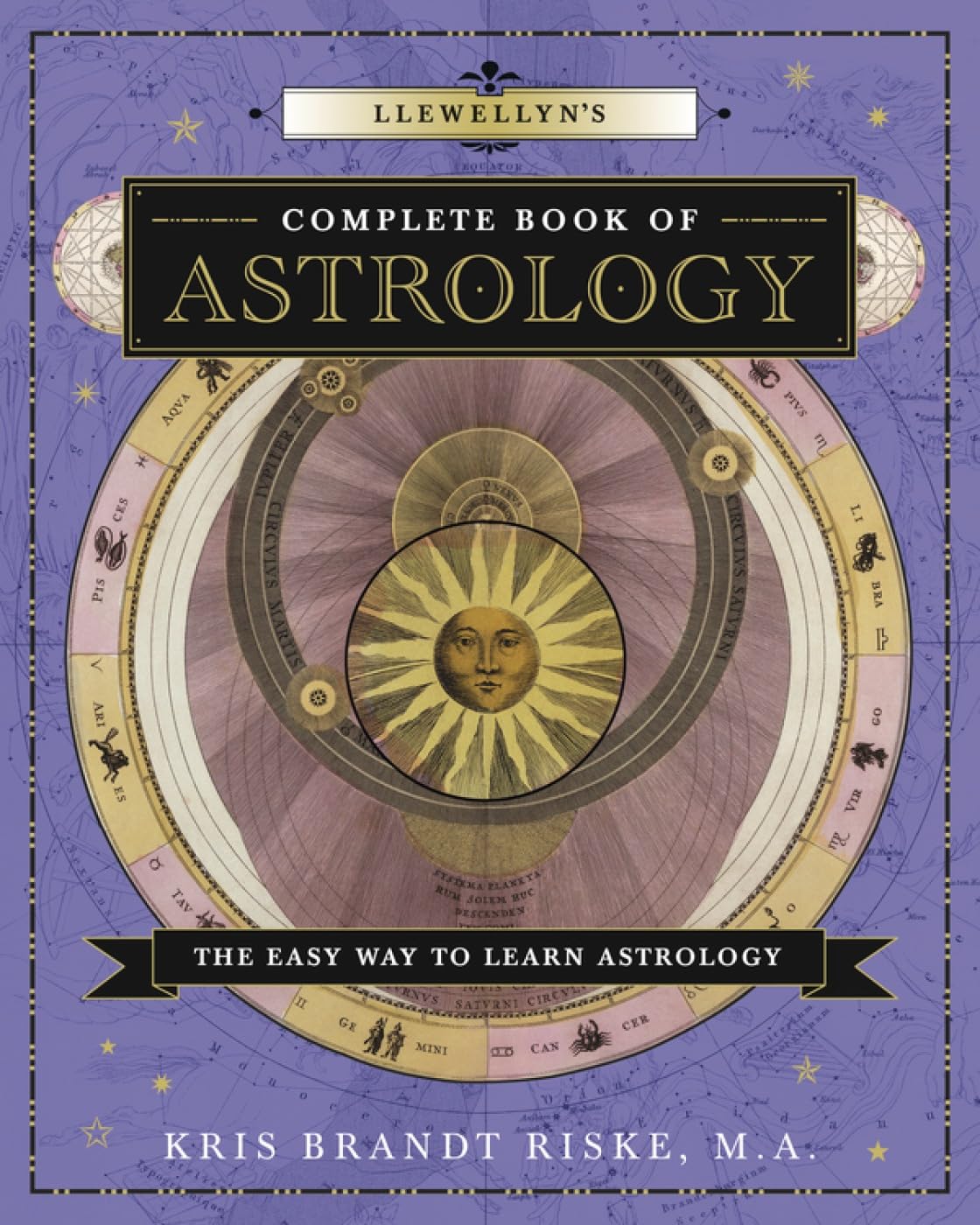
Description:
The easiest way to learn astrology is to start with yourself. Your astrological birth chart is a powerful tool for gaining a deeper understanding of your unique gifts, talents, challenges, and life's purpose. As you begin to decipher the wealth of information in your own birth chart, you'll experience astrology in a personally meaningful way―which makes it easier to understand and remember. Once you learn the basics of astrology, you'll be able to read the birth charts of yourself and others.
This friendly guidebook is the most complete introduction to astrology available. Popular astrologer Kris Brandt Riske presents the essentials of astrology in a clear, step-by-step way, paying special attention to three areas of popular interest: relationships, career, and money. She explains the meaning of the planets, zodiac signs, houses, and aspects, and how to interpret their significance in your chart. Over 30 illustrations, including the birth charts of several famous people―Al Gore, Oprah Winfrey, Brad Pitt, and Tiger Woods, to name just a few―add a helpful visual dimension to your learning experience.
Practical and positive, Llewellyn's Complete Book of Astrology offers techniques for using astrology to identify the qualities you seek in an ideal mate, realize your career and financial potential, calculate your luck, and discover your inner strength.
Review
"Perfect for the beginner or someone that wants to know how to interpret their own birth chart. It explains all the basics of Astrology in simple, easy-to-follow steps."―Prediction Magazine
"A fun, concise guide for anyone with an interest in astrology."―newWitch
"If you want to teach a class, or just learn astrology on your own, this book will make a comprehensive, clearly written companion."―Dell Horoscope
"Overall, an excellent book, and the best new introduction to astrology in many years."―AstroAmerica.com
"Kris does this all with such style and grace that, even though it is a textbook, it is a pleasure to read."―Maya del Mar's Daykeeper Journal
About the Author
Kris Brandt Riske, MA, (Arizona) is the executive director and a professional member of the American Federation of Astrologers (AFA), the oldest US astrological organization, founded in 1938. She is also a member of the National Council for Geocosmic Research (NCGR). She has a master's degree in journalism and a certificate of achievement in weather forecasting from Penn State.
Kris has been a speaker at various astrological conferences and has written for several astrological publications. She wrote the annual weather forecast for Llewellyn's Moon Sign Book for more than ten years, and she is the author of Llewellyn's Complete Book of Astrology and Llewellyn's Complete Book of Predictive Astrology. In addition to astrometeorology, she specializes in predictive astrology.
Kris is an avid NASCAR fan and enjoys gardening and reading.
Excerpt. © Reprinted by permission. All rights reserved.
that focus on the year ahead. These forecasts are based on your Sun sign, which is easily
determined by your birth month and day. You might even know some of the characteristics
associated with your Sun sign and those of family and friends. Sun sign descriptions are amazingly
accurate, even though there's no rational explanation why astrology should work. After all, the
Sun, Moon, and planets are millions of miles away from Earth. How can a body in outer space
realistically affect a person on Earth?
A Sun sign is just a Sun sign. It's important, yes, because it's the essence of you. It's your ego at
work. But from an astrological viewpoint, there's so much more that defines you-your character,
talents, strengths, and challenges.
The ancient Babylonians were as perplexed by this astrological phenomenon as we are today. In
the four thousand or so years since they invented astrology, no one has discovered an explanation
for why it works. But work it does.
Around the sixteenth century BC, the Babylonians began to observe that events on Earth could
be correlated to celestial phenomena. Their brand of astrology is what is today called mundane astrology,
or the astrology of countries, wars, coups, economic conditions, and weather, to name a few. It
eventually evolved into what is now known as electional astrology, the branch in which the planetary
positions are used to select a favorable time to launch an event, such as a wedding, business opening,
meeting, or job application. Babylonian astrologers used the 360° circle (a zodiac of twelve signs similar
to what is used today) and also developed ephemeredes (tables of astrological data) that listed the
planetary positions and eclipses. At that point in time, no connection had been made between astrology and the individual.
It wasn't until more than a thousand years later, sometime between the seventh and fourth centuries BC, that the Babylonians developed
the concept of natal astrology. The natal horoscopesof the time, which probably were limited to royalty and wealthy people, were inscribed on
cuneiform tablets and listed the planetary positions along with comments referring to wealth potential, longevity, family, and status. The natal
horoscope was seen as a predictor of the person's life, much as it is today, the difference being that twenty-first-century astrologers-and people-
recognize that everyone has free will; the Babylonians considered the chart fateful.
The Babylonian knowledge was passed to the Persians, Egyptians, and Indians. It was readily adopted in India, where today it is considered
not only valid but necessary to a successful life.Great advances in astrology were made in Alexandria, Egypt, in the second and third centuries
AD, partly as a result of King Ptolemy I Soter, who ordered the construction of a great library that attracted scholars. During this
period, the following concepts were developed: the Ascendant (rising sign) and Midheaven, astrological houses, planetary rulers, aspects,
and predictive techniques. Astrology was considered a science and spread to western Europe, where educated people knew Greek and Latin.
Although astrology died out in western Europe with the collapse of the Western Roman Empire, it survived somewhat in the Eastern
Roman Empire. A general revival of astrology began around 1000 AD and continued for the next five hundred years. Like all else, astrology
benefited from the invention of the printing press, which made information more readily available to the populace. Astrology was taught
in colleges and universities and was a required subject for medical students.
Astrology then experienced another decline, which began in the late seventeenth century and lasted about two hundred years. It was
still popular in England, however, because the annual astrological almanacs that had been printed since the sixteenth century continued to
be in demand by the public. Renewed interest in astrology developed in the eighteenth and nineteenth centuries, but it wasn't until the 1930s
that first weekly and then daily horoscopes began to appear in newspapers. The first such column appeared in the London Sunday Express.
The twentieth century saw refinements in astrological technique and an emphasis on psychological astrology versus event-oriented
astrology. But the basics remain the same today as those developed by the earliest astrologers, and there is a growing interest in older astrological
literature as more of these works are translated and made available.
why study astrology?
Metaphysics encompasses a wide range of subjects and areas, most of which are focused solely on divination, or predicting the future.
What makes astrology different from the tarot, I Ching, runes, and other forecasting methods is that it is all-encompassing. You can use astrology
not only to forecast events but also to gain great insights into your personality. You may think you know yourself better than anyone else
walking the planet; that's probably true. But has someone ever commented on a personality trait that you were unaware of, at least on a conscious
level? Something that you only then realized was a strength-or a detriment-because it is such a natural part of your personality? Something that
made you realize you'd just discovered another whole side of yourself ? This is part of the natural growth process.
Have you ever asked yourself why you react the way you do in certain situations? Why you repeat negative behaviors even though you
know better? Have you ever knocked yourself out trying to do something, when your energy would have been better directed elsewhere?
This, too, is part of the natural growth process. It is how we evolve as humans.
Now suppose you had all this information sooner rather than later. You'd be able to use it to your advantage for many more years, to make
the most of your potential and in essence speed up that growth process. After all, we don't have all that many years in a lifetime to do everything
we want to do.
This is one fabulous reason to study astrology: self-knowledge is the ultimate form of personal empowerment.
You may have heard people say that astrology is difficult, that it requires “all that math.”
Yes and no.
The math of astrology is nothing more than simple addition and subtraction using preset formulas. But in today's world you don't ever
have to pick up a pencil. There are numerous online sites where you can get a computer-calculated birth chart in seconds (see appendix
III), or you can take advantage of the free birth chart offer at the back of this book. Later, when you're more advanced in your studies and want
to become a certified astrologer, you can learn the math in preparation for taking an exam. Or, if you're not at all intimidated by math or just want
to challenge yourself, you might want to learn this nuts-and-bolts side of astrology now. The point is that it's no longer necessary to first learn the calculations.You can get started right now! Now, the question about difficulty. Is astrology difficult or isn't it? Yes, it is, or can be, but
no, it's not.
Have you ever done anything in your life that was difficult at first but then came easily, such as playing a musical instrument or sport, speaking
in public, or learning a language? Chances are, you have. And each came with a learning curve that began with initial excitement and quickly
acquired skills, followed by the middle ground that required more study or practice to jump the hurdle to a comfort zone of confidence.
Learning astrology is no different than learning anything else. It requires some patience and a lot of practice.
But how difficult is it, really, to read a birth chart? To glean all the insightful information about you and your personality? Not as hard
as you might think. It's a matter of learning what each factor in the birth chart symbolizes and then blending the information until you
have a full picture. Although that might seem like an oversimplified answer, consider this example using astrological keywords, which is
the way every future astrologer learns to interpret a chart: Sun (ego) in Capricorn (ambitious) in the personal financial sector (second house)
conjunct (next to) Jupiter (expansion) adds up to an individual whose self-esteem is linked to achievement and high earnings but who also spends freely on status symbols. It's that simple!
Details:
Visit the Llewellyn Publications Store
Llewellyn's Complete Book of Astrology: The Easy Way to Learn Astrology (Llewellyn's Complete Book Series, 1)
BHD1408
Quantity:
Order today to get by 7-14 business days
Delivery fee of BHD 2. Free for orders above BHD 20.
 Imported From: United States
At BOLO, we work hard to ensure the products you receive are new, genuine, and sourced from reputable suppliers.
Every product in the BOLO catalogue is sourced through our Verified Global Supply Network of verified sellers, authorized distributors or directly from the manufacturer.
Each product undergoes thorough inspection and verification at our consolidation and fulfilment centers to ensure it meets our strict authenticity and quality standards before being shipped and delivered to you.
If you ever have concerns regarding the authenticity of a product purchased from us, please contact Bolo Support. We will review your inquiry promptly and, if necessary, provide documentation verifying authenticity or offer a suitable resolution.
Your trust is our top priority, and we are committed to maintaining transparency and integrity in every transaction.
While we strive to display accurate information, variations in packaging, labeling, instructions, or formulation may occasionally occur due to regional differences or supplier updates. For detailed or manufacturer-specific information, please contact the brand directly or reach out to BOLO Support for assistance.
Unless otherwise stated, all prices displayed on the product page include applicable taxes and import duties.
BOLO operates in accordance with the laws and regulations of Bahrain. Any items found to be restricted or prohibited for sale within the Bahrain will be cancelled prior to shipment. We take proactive measures to ensure that only products permitted for sale in Bahrain are listed on our website.
All items are shipped by air, and any products classified as “Dangerous Goods (DG)” under IATA regulations will be removed from the order and cancelled.
All orders are processed manually, and we make every effort to process them promptly once confirmed. Products cancelled due to the above reasons will be permanently removed from listings across the website.


More from this brand
Similar items from “Astrology”
Share with
Or share with link
https://www.bolo.bh/products/U0738710717
Visit the Llewellyn Publications Store
Llewellyn's Complete Book of Astrology: The Easy Way to Learn Astrology (Llewellyn's Complete Book Series, 1)
BHD1408
Quantity:
Order today to get by 7-14 business days
Delivery fee of BHD 2. Free for orders above BHD 20.
Imported From: United States
At BOLO, we work hard to ensure the products you receive are new, genuine, and sourced from reputable suppliers.
Every product in the BOLO catalogue is sourced through our Verified Global Supply Network of verified sellers, authorized distributors or directly from the manufacturer.
Each product undergoes thorough inspection and verification at our consolidation and fulfilment centers to ensure it meets our strict authenticity and quality standards before being shipped and delivered to you.
If you ever have concerns regarding the authenticity of a product purchased from us, please contact Bolo Support. We will review your inquiry promptly and, if necessary, provide documentation verifying authenticity or offer a suitable resolution.
Your trust is our top priority, and we are committed to maintaining transparency and integrity in every transaction.
While we strive to display accurate information, variations in packaging, labeling, instructions, or formulation may occasionally occur due to regional differences or supplier updates. For detailed or manufacturer-specific information, please contact the brand directly or reach out to BOLO Support for assistance.
Unless otherwise stated, all prices displayed on the product page include applicable taxes and import duties.
BOLO operates in accordance with the laws and regulations of Bahrain. Any items found to be restricted or prohibited for sale within the Bahrain will be cancelled prior to shipment. We take proactive measures to ensure that only products permitted for sale in Bahrain are listed on our website.
All items are shipped by air, and any products classified as “Dangerous Goods (DG)” under IATA regulations will be removed from the order and cancelled.
All orders are processed manually, and we make every effort to process them promptly once confirmed. Products cancelled due to the above reasons will be permanently removed from listings across the website.
Description:
The easiest way to learn astrology is to start with yourself. Your astrological birth chart is a powerful tool for gaining a deeper understanding of your unique gifts, talents, challenges, and life's purpose. As you begin to decipher the wealth of information in your own birth chart, you'll experience astrology in a personally meaningful way―which makes it easier to understand and remember. Once you learn the basics of astrology, you'll be able to read the birth charts of yourself and others.
This friendly guidebook is the most complete introduction to astrology available. Popular astrologer Kris Brandt Riske presents the essentials of astrology in a clear, step-by-step way, paying special attention to three areas of popular interest: relationships, career, and money. She explains the meaning of the planets, zodiac signs, houses, and aspects, and how to interpret their significance in your chart. Over 30 illustrations, including the birth charts of several famous people―Al Gore, Oprah Winfrey, Brad Pitt, and Tiger Woods, to name just a few―add a helpful visual dimension to your learning experience.
Practical and positive, Llewellyn's Complete Book of Astrology offers techniques for using astrology to identify the qualities you seek in an ideal mate, realize your career and financial potential, calculate your luck, and discover your inner strength.
Review
"Perfect for the beginner or someone that wants to know how to interpret their own birth chart. It explains all the basics of Astrology in simple, easy-to-follow steps."―Prediction Magazine
"A fun, concise guide for anyone with an interest in astrology."―newWitch
"If you want to teach a class, or just learn astrology on your own, this book will make a comprehensive, clearly written companion."―Dell Horoscope
"Overall, an excellent book, and the best new introduction to astrology in many years."―AstroAmerica.com
"Kris does this all with such style and grace that, even though it is a textbook, it is a pleasure to read."―Maya del Mar's Daykeeper Journal
About the Author
Kris Brandt Riske, MA, (Arizona) is the executive director and a professional member of the American Federation of Astrologers (AFA), the oldest US astrological organization, founded in 1938. She is also a member of the National Council for Geocosmic Research (NCGR). She has a master's degree in journalism and a certificate of achievement in weather forecasting from Penn State.
Kris has been a speaker at various astrological conferences and has written for several astrological publications. She wrote the annual weather forecast for Llewellyn's Moon Sign Book for more than ten years, and she is the author of Llewellyn's Complete Book of Astrology and Llewellyn's Complete Book of Predictive Astrology. In addition to astrometeorology, she specializes in predictive astrology.
Kris is an avid NASCAR fan and enjoys gardening and reading.
Excerpt. © Reprinted by permission. All rights reserved.
that focus on the year ahead. These forecasts are based on your Sun sign, which is easily
determined by your birth month and day. You might even know some of the characteristics
associated with your Sun sign and those of family and friends. Sun sign descriptions are amazingly
accurate, even though there's no rational explanation why astrology should work. After all, the
Sun, Moon, and planets are millions of miles away from Earth. How can a body in outer space
realistically affect a person on Earth?
A Sun sign is just a Sun sign. It's important, yes, because it's the essence of you. It's your ego at
work. But from an astrological viewpoint, there's so much more that defines you-your character,
talents, strengths, and challenges.
The ancient Babylonians were as perplexed by this astrological phenomenon as we are today. In
the four thousand or so years since they invented astrology, no one has discovered an explanation
for why it works. But work it does.
Around the sixteenth century BC, the Babylonians began to observe that events on Earth could
be correlated to celestial phenomena. Their brand of astrology is what is today called mundane astrology,
or the astrology of countries, wars, coups, economic conditions, and weather, to name a few. It
eventually evolved into what is now known as electional astrology, the branch in which the planetary
positions are used to select a favorable time to launch an event, such as a wedding, business opening,
meeting, or job application. Babylonian astrologers used the 360° circle (a zodiac of twelve signs similar
to what is used today) and also developed ephemeredes (tables of astrological data) that listed the
planetary positions and eclipses. At that point in time, no connection had been made between astrology and the individual.
It wasn't until more than a thousand years later, sometime between the seventh and fourth centuries BC, that the Babylonians developed
the concept of natal astrology. The natal horoscopesof the time, which probably were limited to royalty and wealthy people, were inscribed on
cuneiform tablets and listed the planetary positions along with comments referring to wealth potential, longevity, family, and status. The natal
horoscope was seen as a predictor of the person's life, much as it is today, the difference being that twenty-first-century astrologers-and people-
recognize that everyone has free will; the Babylonians considered the chart fateful.
The Babylonian knowledge was passed to the Persians, Egyptians, and Indians. It was readily adopted in India, where today it is considered
not only valid but necessary to a successful life.Great advances in astrology were made in Alexandria, Egypt, in the second and third centuries
AD, partly as a result of King Ptolemy I Soter, who ordered the construction of a great library that attracted scholars. During this
period, the following concepts were developed: the Ascendant (rising sign) and Midheaven, astrological houses, planetary rulers, aspects,
and predictive techniques. Astrology was considered a science and spread to western Europe, where educated people knew Greek and Latin.
Although astrology died out in western Europe with the collapse of the Western Roman Empire, it survived somewhat in the Eastern
Roman Empire. A general revival of astrology began around 1000 AD and continued for the next five hundred years. Like all else, astrology
benefited from the invention of the printing press, which made information more readily available to the populace. Astrology was taught
in colleges and universities and was a required subject for medical students.
Astrology then experienced another decline, which began in the late seventeenth century and lasted about two hundred years. It was
still popular in England, however, because the annual astrological almanacs that had been printed since the sixteenth century continued to
be in demand by the public. Renewed interest in astrology developed in the eighteenth and nineteenth centuries, but it wasn't until the 1930s
that first weekly and then daily horoscopes began to appear in newspapers. The first such column appeared in the London Sunday Express.
The twentieth century saw refinements in astrological technique and an emphasis on psychological astrology versus event-oriented
astrology. But the basics remain the same today as those developed by the earliest astrologers, and there is a growing interest in older astrological
literature as more of these works are translated and made available.
why study astrology?
Metaphysics encompasses a wide range of subjects and areas, most of which are focused solely on divination, or predicting the future.
What makes astrology different from the tarot, I Ching, runes, and other forecasting methods is that it is all-encompassing. You can use astrology
not only to forecast events but also to gain great insights into your personality. You may think you know yourself better than anyone else
walking the planet; that's probably true. But has someone ever commented on a personality trait that you were unaware of, at least on a conscious
level? Something that you only then realized was a strength-or a detriment-because it is such a natural part of your personality? Something that
made you realize you'd just discovered another whole side of yourself ? This is part of the natural growth process.
Have you ever asked yourself why you react the way you do in certain situations? Why you repeat negative behaviors even though you
know better? Have you ever knocked yourself out trying to do something, when your energy would have been better directed elsewhere?
This, too, is part of the natural growth process. It is how we evolve as humans.
Now suppose you had all this information sooner rather than later. You'd be able to use it to your advantage for many more years, to make
the most of your potential and in essence speed up that growth process. After all, we don't have all that many years in a lifetime to do everything
we want to do.
This is one fabulous reason to study astrology: self-knowledge is the ultimate form of personal empowerment.
You may have heard people say that astrology is difficult, that it requires “all that math.”
Yes and no.
The math of astrology is nothing more than simple addition and subtraction using preset formulas. But in today's world you don't ever
have to pick up a pencil. There are numerous online sites where you can get a computer-calculated birth chart in seconds (see appendix
III), or you can take advantage of the free birth chart offer at the back of this book. Later, when you're more advanced in your studies and want
to become a certified astrologer, you can learn the math in preparation for taking an exam. Or, if you're not at all intimidated by math or just want
to challenge yourself, you might want to learn this nuts-and-bolts side of astrology now. The point is that it's no longer necessary to first learn the calculations.You can get started right now! Now, the question about difficulty. Is astrology difficult or isn't it? Yes, it is, or can be, but
no, it's not.
Have you ever done anything in your life that was difficult at first but then came easily, such as playing a musical instrument or sport, speaking
in public, or learning a language? Chances are, you have. And each came with a learning curve that began with initial excitement and quickly
acquired skills, followed by the middle ground that required more study or practice to jump the hurdle to a comfort zone of confidence.
Learning astrology is no different than learning anything else. It requires some patience and a lot of practice.
But how difficult is it, really, to read a birth chart? To glean all the insightful information about you and your personality? Not as hard
as you might think. It's a matter of learning what each factor in the birth chart symbolizes and then blending the information until you
have a full picture. Although that might seem like an oversimplified answer, consider this example using astrological keywords, which is
the way every future astrologer learns to interpret a chart: Sun (ego) in Capricorn (ambitious) in the personal financial sector (second house)
conjunct (next to) Jupiter (expansion) adds up to an individual whose self-esteem is linked to achievement and high earnings but who also spends freely on status symbols. It's that simple!
Details:
More from this brand
Similar items from “Astrology”
Share with
Or share with link
https://www.bolo.bh/products/U0738710717