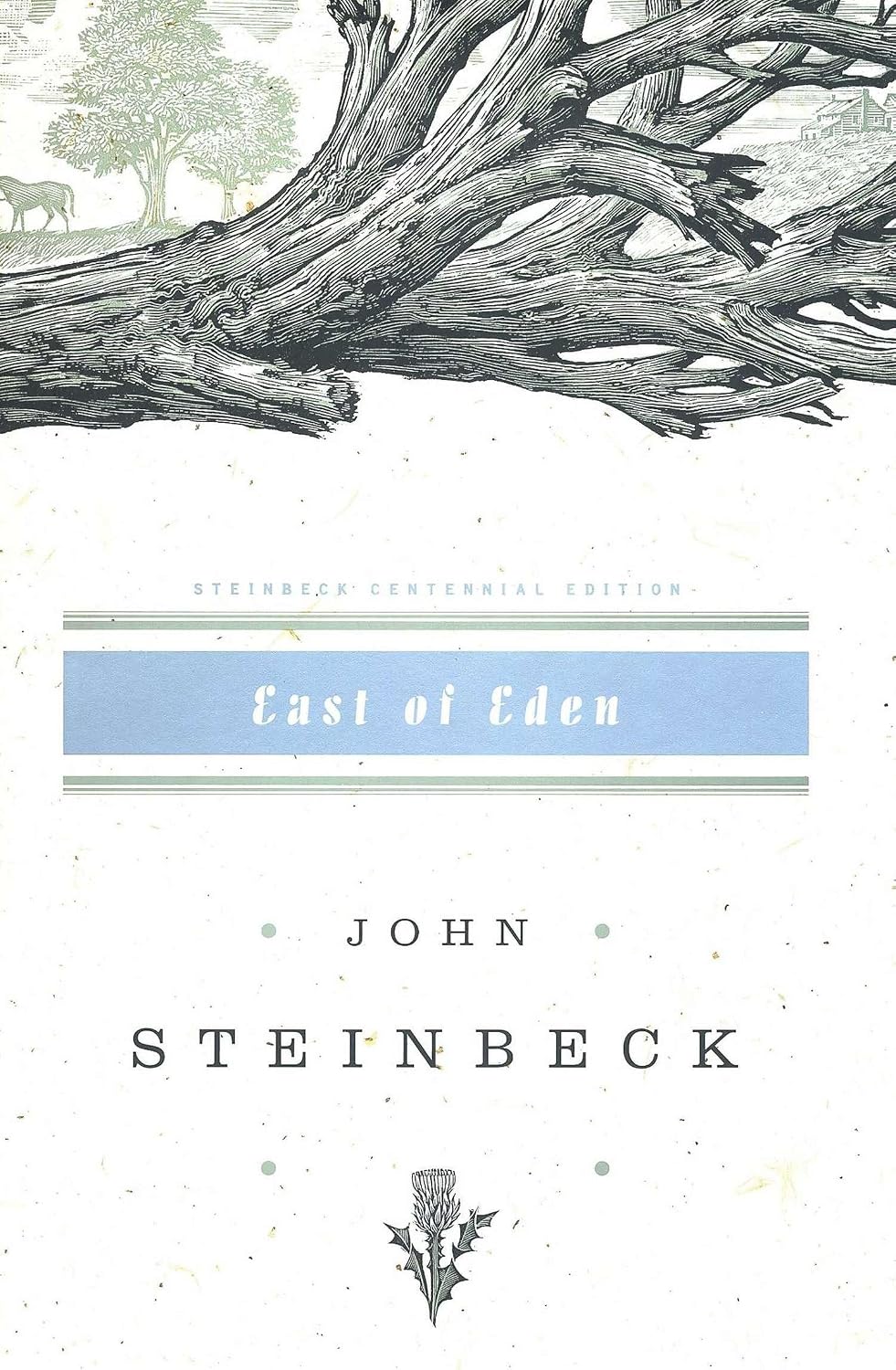
Description:
In his journal, Nobel Prize winner John Steinbeck called East of Eden "the first book," and indeed it has the primordial power and simplicity of myth. Set in the rich farmland of California's Salinas Valley, this sprawling and often brutal novel follows the intertwined destinies of two families—the Trasks and the Hamiltons—whose generations helplessly reenact the fall of Adam and Eve and the poisonous rivalry of Cain and Abel.
The masterpiece of Steinbeck’s later years, East of Eden is a work in which Steinbeck created his most mesmerizing characters and explored his most enduring themes: the mystery of identity, the inexplicability of love, and the murderous consequences of love's absence. Adapted for the 1955 film directed by Elia Kazan introducing James Dean, and read by thousands as the book that brought Oprah’s Book Club back, East of Eden has remained vitally present in American culture for over half a century.
Review
—The New York Herald Tribune
"A fantasia and myth...a strange and original work of art."
—The New York Times Book Review
"A moving, crying pageant with wilderness strengths."
—Carl Sandburg
"When the book club ended a year ago, I said I would bring it back when I found the book that was moving…and this is a great one. I read it for myself for the first time and then I had some friends read it. And we think it might be the best novel we've ever read!"
—Oprah Winfrey
About the Author
After marriage and a move to Pacific Grove, he published two California books, The Pastures of Heaven (1932) and To a God Unknown (1933), and worked on short stories later collected in The Long Valley (1938). Popular success and financial security came only with Tortilla Flat (1935), stories about Monterey’s paisanos. A ceaseless experimenter throughout his career, Steinbeck changed courses regularly. Three powerful novels of the late 1930s focused on the California laboring class: In Dubious Battle (1936), Of Mice and Men (1937), and the book considered by many his finest, The Grapes of Wrath (1939). The Grapes of Wrath won both the National Book Award and the Pulitzer Prize in 1939.
Early in the 1940s, Steinbeck became a filmmaker with The Forgotten Village (1941) and a serious student of marine biology with Sea of Cortez (1941). He devoted his services to the war, writing Bombs Away (1942) and the controversial play-novelette The Moon is Down (1942). Cannery Row (1945), The Wayward Bus (1948), another experimental drama, Burning Bright (1950), and The Log from the Sea of Cortez (1951) preceded publication of the monumental East of Eden (1952), an ambitious saga of the Salinas Valley and his own family’s history.
The last decades of his life were spent in New York City and Sag Harbor with his third wife, with whom he traveled widely. Later books include Sweet Thursday (1954), The Short Reign of Pippin IV: A Fabrication (1957), Once There Was a War (1958), The Winter of Our Discontent (1961), Travels with Charley in Search of America (1962), America and Americans (1966), and the posthumously published Journal of a Novel: The East of Eden Letters (1969), Viva Zapata! (1975), The Acts of King Arthur and His Noble Knights (1976), and Working Days: The Journals of The Grapes of Wrath (1989).
Steinbeck received the Nobel Prize in Literature in 1962, and, in 1964, he was presented with the United States Medal of Freedom by President Lyndon B. Johnson. Steinbeck died in New York in 1968. Today, more than thirty years after his death, he remains one of America's greatest writers and cultural figures.
Excerpt. © Reprinted by permission. All rights reserved.
Chapter 1
[1]
THE SALINAS VALLEY is in Northern California. It is a long narrow swale between two ranges of mountains, and the Salinas River winds and twists up the center until it falls at last into Monterey Bay.
I remember my childhood names for grasses and secret flowers. I remember where a toad may live and what time the birds awaken in the summer—and what trees and seasons smelled like—how people looked and walked and smelled even. The memory of odors is very rich.
I remember that the Gabilan Mountains to the east of the valley were light gay mountains full of sun and loveliness and a kind of invitation, so that you wanted to climb into their warm foothills almost as you want to climb into the lap of a beloved mother. They were beckoning mountains with a brown grass love. The Santa Lucias stood up against the sky to the west and kept the valley from the open sea, and they were dark and brooding—unfriendly and dangerous. I always found in myself a dread of west and a love of east. Where I ever got such an idea I cannot say, unless it could be that the morning came over the peaks of the Gabilans and the night drifted back from the ridges of the Santa Lucias. It may be that the birth and death of the day had some part in my feeling about the two ranges of mountains.
From both sides of the valley little streams slipped out of the hill canyons and fell into the bed of the Salinas River. In the winter of wet years the streams ran full-freshet, and they swelled the river until sometimes it raged and boiled, bank full, and then it was a destroyer. The river tore the edges of the farm lands and washed whole acres down; it toppled barns and houses into itself, to go floating and bobbing away. It trapped cows and pigs and sheep and drowned them in its muddy brown water and carried them to the sea. Then when the late spring came, the river drew in from its edges and the sand banks appeared. And in the summer the river didn’t run at all above ground. Some pools would be left in the deep swirl places under a high bank. The tules and grasses grew back, and willows straightened up with the flood debris in their upper branches. The Salinas was only a part-time river. The summer sun drove it underground. It was not a fine river at all, but it was the only one we had and so we boasted about it—how dangerous it was in a wet winter and how dry it was in a dry summer. You can boast about anything if it’s all you have. Maybe the less you have, the more you are required to boast.
Details:
Visit the Viking Store
East of Eden
BHD3162
Quantity:
Order today to get by 7-14 business days
This item qualifies for free delivery
 Imported From: United States
At BOLO, we work hard to ensure the products you receive are new, genuine, and sourced from reputable suppliers.
Every product in the BOLO catalogue is sourced through our Verified Global Supply Network of verified sellers, authorized distributors or directly from the manufacturer.
Each product undergoes thorough inspection and verification at our consolidation and fulfilment centers to ensure it meets our strict authenticity and quality standards before being shipped and delivered to you.
If you ever have concerns regarding the authenticity of a product purchased from us, please contact Bolo Support. We will review your inquiry promptly and, if necessary, provide documentation verifying authenticity or offer a suitable resolution.
Your trust is our top priority, and we are committed to maintaining transparency and integrity in every transaction.
While we strive to display accurate information, variations in packaging, labeling, instructions, or formulation may occasionally occur due to regional differences or supplier updates. For detailed or manufacturer-specific information, please contact the brand directly or reach out to BOLO Support for assistance.
Unless otherwise stated, all prices displayed on the product page include applicable taxes and import duties.
BOLO operates in accordance with the laws and regulations of Bahrain. Any items found to be restricted or prohibited for sale within the Bahrain will be cancelled prior to shipment. We take proactive measures to ensure that only products permitted for sale in Bahrain are listed on our website.
All items are shipped by air, and any products classified as “Dangerous Goods (DG)” under IATA regulations will be removed from the order and cancelled.
All orders are processed manually, and we make every effort to process them promptly once confirmed. Products cancelled due to the above reasons will be permanently removed from listings across the website.
More from this brand
Similar items from “Multigenerational”
Share with
Or share with link
https://www.bolo.bh/products/U0670033049
Visit the Viking Store
East of Eden
BHD3162
Quantity:
Order today to get by 7-14 business days
This item qualifies for free delivery
Imported From: United States
At BOLO, we work hard to ensure the products you receive are new, genuine, and sourced from reputable suppliers.
Every product in the BOLO catalogue is sourced through our Verified Global Supply Network of verified sellers, authorized distributors or directly from the manufacturer.
Each product undergoes thorough inspection and verification at our consolidation and fulfilment centers to ensure it meets our strict authenticity and quality standards before being shipped and delivered to you.
If you ever have concerns regarding the authenticity of a product purchased from us, please contact Bolo Support. We will review your inquiry promptly and, if necessary, provide documentation verifying authenticity or offer a suitable resolution.
Your trust is our top priority, and we are committed to maintaining transparency and integrity in every transaction.
While we strive to display accurate information, variations in packaging, labeling, instructions, or formulation may occasionally occur due to regional differences or supplier updates. For detailed or manufacturer-specific information, please contact the brand directly or reach out to BOLO Support for assistance.
Unless otherwise stated, all prices displayed on the product page include applicable taxes and import duties.
BOLO operates in accordance with the laws and regulations of Bahrain. Any items found to be restricted or prohibited for sale within the Bahrain will be cancelled prior to shipment. We take proactive measures to ensure that only products permitted for sale in Bahrain are listed on our website.
All items are shipped by air, and any products classified as “Dangerous Goods (DG)” under IATA regulations will be removed from the order and cancelled.
All orders are processed manually, and we make every effort to process them promptly once confirmed. Products cancelled due to the above reasons will be permanently removed from listings across the website.
Description:
In his journal, Nobel Prize winner John Steinbeck called East of Eden "the first book," and indeed it has the primordial power and simplicity of myth. Set in the rich farmland of California's Salinas Valley, this sprawling and often brutal novel follows the intertwined destinies of two families—the Trasks and the Hamiltons—whose generations helplessly reenact the fall of Adam and Eve and the poisonous rivalry of Cain and Abel.
The masterpiece of Steinbeck’s later years, East of Eden is a work in which Steinbeck created his most mesmerizing characters and explored his most enduring themes: the mystery of identity, the inexplicability of love, and the murderous consequences of love's absence. Adapted for the 1955 film directed by Elia Kazan introducing James Dean, and read by thousands as the book that brought Oprah’s Book Club back, East of Eden has remained vitally present in American culture for over half a century.
Review
—The New York Herald Tribune
"A fantasia and myth...a strange and original work of art."
—The New York Times Book Review
"A moving, crying pageant with wilderness strengths."
—Carl Sandburg
"When the book club ended a year ago, I said I would bring it back when I found the book that was moving…and this is a great one. I read it for myself for the first time and then I had some friends read it. And we think it might be the best novel we've ever read!"
—Oprah Winfrey
About the Author
After marriage and a move to Pacific Grove, he published two California books, The Pastures of Heaven (1932) and To a God Unknown (1933), and worked on short stories later collected in The Long Valley (1938). Popular success and financial security came only with Tortilla Flat (1935), stories about Monterey’s paisanos. A ceaseless experimenter throughout his career, Steinbeck changed courses regularly. Three powerful novels of the late 1930s focused on the California laboring class: In Dubious Battle (1936), Of Mice and Men (1937), and the book considered by many his finest, The Grapes of Wrath (1939). The Grapes of Wrath won both the National Book Award and the Pulitzer Prize in 1939.
Early in the 1940s, Steinbeck became a filmmaker with The Forgotten Village (1941) and a serious student of marine biology with Sea of Cortez (1941). He devoted his services to the war, writing Bombs Away (1942) and the controversial play-novelette The Moon is Down (1942). Cannery Row (1945), The Wayward Bus (1948), another experimental drama, Burning Bright (1950), and The Log from the Sea of Cortez (1951) preceded publication of the monumental East of Eden (1952), an ambitious saga of the Salinas Valley and his own family’s history.
The last decades of his life were spent in New York City and Sag Harbor with his third wife, with whom he traveled widely. Later books include Sweet Thursday (1954), The Short Reign of Pippin IV: A Fabrication (1957), Once There Was a War (1958), The Winter of Our Discontent (1961), Travels with Charley in Search of America (1962), America and Americans (1966), and the posthumously published Journal of a Novel: The East of Eden Letters (1969), Viva Zapata! (1975), The Acts of King Arthur and His Noble Knights (1976), and Working Days: The Journals of The Grapes of Wrath (1989).
Steinbeck received the Nobel Prize in Literature in 1962, and, in 1964, he was presented with the United States Medal of Freedom by President Lyndon B. Johnson. Steinbeck died in New York in 1968. Today, more than thirty years after his death, he remains one of America's greatest writers and cultural figures.
Excerpt. © Reprinted by permission. All rights reserved.
Chapter 1
[1]
THE SALINAS VALLEY is in Northern California. It is a long narrow swale between two ranges of mountains, and the Salinas River winds and twists up the center until it falls at last into Monterey Bay.
I remember my childhood names for grasses and secret flowers. I remember where a toad may live and what time the birds awaken in the summer—and what trees and seasons smelled like—how people looked and walked and smelled even. The memory of odors is very rich.
I remember that the Gabilan Mountains to the east of the valley were light gay mountains full of sun and loveliness and a kind of invitation, so that you wanted to climb into their warm foothills almost as you want to climb into the lap of a beloved mother. They were beckoning mountains with a brown grass love. The Santa Lucias stood up against the sky to the west and kept the valley from the open sea, and they were dark and brooding—unfriendly and dangerous. I always found in myself a dread of west and a love of east. Where I ever got such an idea I cannot say, unless it could be that the morning came over the peaks of the Gabilans and the night drifted back from the ridges of the Santa Lucias. It may be that the birth and death of the day had some part in my feeling about the two ranges of mountains.
From both sides of the valley little streams slipped out of the hill canyons and fell into the bed of the Salinas River. In the winter of wet years the streams ran full-freshet, and they swelled the river until sometimes it raged and boiled, bank full, and then it was a destroyer. The river tore the edges of the farm lands and washed whole acres down; it toppled barns and houses into itself, to go floating and bobbing away. It trapped cows and pigs and sheep and drowned them in its muddy brown water and carried them to the sea. Then when the late spring came, the river drew in from its edges and the sand banks appeared. And in the summer the river didn’t run at all above ground. Some pools would be left in the deep swirl places under a high bank. The tules and grasses grew back, and willows straightened up with the flood debris in their upper branches. The Salinas was only a part-time river. The summer sun drove it underground. It was not a fine river at all, but it was the only one we had and so we boasted about it—how dangerous it was in a wet winter and how dry it was in a dry summer. You can boast about anything if it’s all you have. Maybe the less you have, the more you are required to boast.
Details:
More from this brand
Similar items from “Multigenerational”
Share with
Or share with link
https://www.bolo.bh/products/U0670033049