Description:
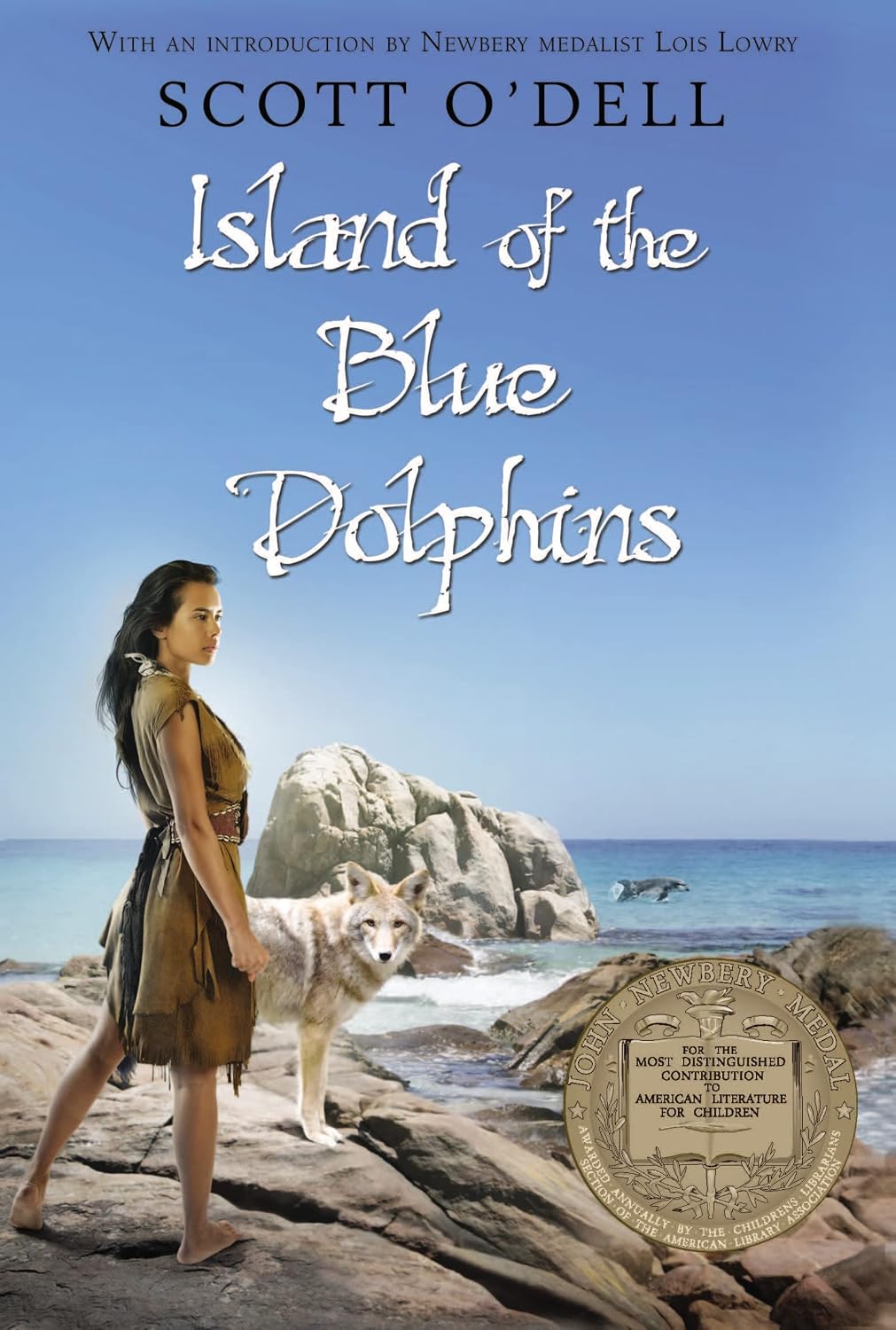
Scott O’Dell's Newbery Medal-winning classic is a gripping tale of survival, strength, and courage. Based on the true story of a Nicoleño Indian girl living alone on an island off the coast of California, Island of the Blue Dolphins has captivated readers for generations.
On San Nicolas Island, dolphins flash in the surrounding blue waters, sea otter play in the vast kelp beds, and sea elephants loll on the stony beaches. Here, in the early 1800s, a girl named Karana spent eighteen years alone.
Karana had to contend with the ferocious pack of wild dogs that killed her younger brother, constantly guard against Aleutian sea otter hunters, and maintain a precarious food supply. Her courage, self-reliance, and grit has inspired millions of readers in this breathtaking adventure.
As Smithsonian magazine put it: "For kids all over the country, reading the book in language arts classes, Karana is a powerful symbol of their growing independence. Through her, they can imagine themselves making their way in the world alone—and thriving."
Safety Information
No Warning Applicable
Amazon.com Review
The Newberry Medal-winning story of a 12-year old girl who lives alone on a Pacific island after she leaps from a rescue ship. Isolated on the island for eighteen years, Karana forages for food, builds weapons to fight predators, clothes herself in a cormorant feathered skirt, and finds strength and peace in her seclusion. A classic tale of discovery and solitude returns to Houghton Mifflin Harcourt for its 50th anniversary, with a new introduction by Lois Lowry.
Amazon Exclusive: A Letter from Lois Lowry on Writing the Introduction to Island of the Blue Dolphins, 50th Anniversary Edition
Dear Amazon readers, Last summer, when I was asked to write an introduction to a new edition of Island of the Blue Dolphins, my mind went back in time to the 1960s, when my children were young and it was one of their best-loved books. But a later memory surfaced, as well, of a party I was invited to in the summer of 1979. By now the kids were grown. I was in New York to attend a convention of the American Library Association, and Scott O'Dell's publisher, Houghton Mifflin, was honoring him at a reception being held at the St. Regis Hotel. I had never met Mr. O'Dell. But because of my own children I knew his books, and I was pleased to be invited to such an illustrious event. I was staying at a nearby hotel and planned to walk over to the party. But when I began to get dressed, I encountered a problem. I was wearing, I remember, a rose-colored crêpe de Chine dress. It buttoned up the back. I was alone in my hotel room. I buttoned the bottom buttons, and I buttoned the top buttons, but there was one button in the middle of my back that I simply couldn’t reach. It makes me laugh today, thinking about it, picturing the contortions I went through in that hotel room: twisting my arms, twisting my back, all to no avail. The clock was ticking. The party would start soon. I had no other clothes except the casual things I'd been wearing all day and which were now wrinkled from the summer heat. Finally I decided, The heck with it. I left the room with the button unbuttoned and headed off. When I got in my hotel elevator, a benign-looking older couple, probably tourists from the Midwest, were already standing inside, and I explained my predicament politely and asked if they could give me a hand. The gray-haired man kindly buttoned my dress for me. We parted company in the lobby of my hotel and off I went to the St. Regis, where I milled around and chatted with countless people, sipped wine, and waited for the guest of honor, Scott O'Dell, to be introduced. When he was, of course he turned out to be the eighty-one-year-old man who had buttoned my dress. But wait! There's more. Ten years passed. I had never seen Mr. O'Dell during the intervening years, but now, suddenly, we were the two speakers at a luncheon being held on a college campus somewhere. I think it may have been Vassar. We sat next to each other at the head table, nibbling our chicken, chatting about the weather. I knew he wouldn't remember me, but I certainly remembered him, and I was secretly thinking that when it was my turn to speak, I might tell the audience the amusing little anecdote about the button on my dress. But he went first. And, eyes twinkling, he started his speech with "The last time I was with Lois Lowry, we were in a New York hotel. I was helping her get dressed." He was ninety-one at the time. All of this floated back into my mind when I found myself rereading, last summer, The Island of the Blue Dolphins. None of it was appropriate to the book's introduction, of course, and I went on to write, instead, about the power of the story and the magnificence of the writing. Not that anyone needed reminding! There has never been a question about Scott O'Dell's brilliance as a writer and storyteller. But it's nice to have a chance, here, to tell an audience that he was also a sweet and funny man.Lois Lowry(Photo © Neil Giordano)
Review
About the Author
Excerpt. © Reprinted by permission. All rights reserved.
Chapter 1
I remember the day the Aleut ship came to our island. At first it seemed like a small shell afloat on the sea. Then it grew larger and was a gull with folded wings. At last in the rising sun it became what it really was—a red ship with two red sails.
My brother and I had gone to the head of a canyon that winds down to a little harbor which is called Coral Cove. We had gone to gather roots that grow there in the spring.
My brother Ramo was only a little boy half my age, which was twelve. He was small for one who had lived so many suns and moons, but quick as a cricket. Also foolish as a cricket when he was excited. For this reason and because I wanted him to help me gather roots and not go running off , I said nothing about the shell I saw or the gull with folded wings.
I went on digging in the brush with my pointed stick as though nothing at all were happening on the sea. Even when I knew for sure that the gull was a ship with two red sails.
But Ramo’s eyes missed little in the world. They were black like a lizard’s and very large and, like the eyes of a lizard, could sometimes look sleepy. This was the time when they saw the most. This was the way they looked now. They were half-closed, like those of a lizard lying on a rock about to flick out its tongue to catch a fly.
"The sea is smooth," Ramo said. "It is a flat stone without any scratches."
My brother liked to pretend that one thing was another.
"The sea is not a stone without scratches," I said. "It is water and no waves."
"To me it is a blue stone," he said. "And far away on the edge of it is a small cloud which sits on the stone."
"Clouds do not sit on stones. On blue ones or black ones or any kind of stones."
"This one does."
"Not on the sea," I said. "Dolphins sit there, and gulls, and cormorants, and otter, and whales too, but not clouds."
"It is a whale, maybe."
Ramo was standing on one foot and then the other, watching the ship coming, which he did not know was a ship because he had never seen one. I had never seen one either, but I knew how they looked because I had been told.
"While you gaze at the sea," I said, "I dig roots. And it is I who will eat them and you who will not."
Ramo began to punch at the earth with his stick, but as the ship came closer, its sails showing red through the morning mist, he kept watching it, acting all the time as if he were not.
"Have you ever seen a red whale?" he asked.
"Yes," I said, though I never had.
"Those I have seen are gray."
"You are very young and have not seen everything that swims in the world."
Ramo picked up a root and was about to drop it into the basket. Suddenly his mouth opened wide and then closed again.
"A canoe!" he cried. "A great one, bigger than all of our canoes together. And red!"
A canoe or a ship, it did not matter to Ramo. In the very next breath he tossed the root in the air and was gone, crashing through the brush, shouting as he went.
I kept on gathering roots, but my hands trembled as I dug in the earth, for I was more excited than my brother. I knew that it was a ship there on the sea and not a big canoe, and that a ship could mean many things. I wanted to drop the stick and run too, but I went on digging roots because they were needed in the village. By the time I filled the basket, the Aleut ship had sailed around the wide kelp bed that encloses our island and between our two rocks that guard Coral Cove. Word of its coming had already reached the village of Ghalas-at. Carrying their weapons, our men sped along the trail which winds down to the shore. Our women were gathering at the edge of the mesa.
I made my way through the heavy brush and, moving swiftly, down the ravine until I came to the sea cliff s. There I crouched on my hands and knees. Below me lay the cove. The tide was out and the sun shone on the white sand of the beach. Half the men from our village stood at the water’s edge. The rest were concealed among the rocks at the foot of the trail, ready to attack the intruders should they prove unfriendly.
As I crouched there in the toyon bushes, trying not to fall over the cliff , trying to keep myself hidden and yet to see and hear what went on below me, a boat left the ship. Six men with long oars were rowing. Their faces were broad, and shining dark hair fell over their eyes. When they came closer I saw that they had bone ornaments thrust through their noses.
Behind them in the boat stood a tall man with a yellow beard. I had never seen a Russian before, but my father had told me about them, and I wondered, seeing the way he stood with his feet set apart and his fists on his hips and looked at the little harbor as though it already belonged to him, if he were one of those men from the north whom our people feared. I was certain of it when the boat slid in to the shore and he jumped out, shouting as he did so.
His voice echoed against the rock walls of the cove. The words were strange, unlike any I had ever heard. Slowly then he spoke in our tongue.
"I come in peace and wish to parley," he said to the men on the shore.
None of them answered, but my father, who was one of those hidden among the rocks, came forward down the sloping beach. He thrust his spear into the sand.
"I am the Chief of Ghalas-at," he said. "My name is Chief Chowig."
I was surprised that he gave his real name to a stranger. Everyone in our tribe had two names, the real one which was secret and was seldom used, and one which was common, for if people use your secret name it becomes worn out and loses its magic. Thus I was known as Won-a-pa-lei, which means The Girl with the Long Black Hair, though my secret name is Karana. My father’s secret name was Chowig. Why he gave it to a stranger I do not know.
The Russian smiled and held up his hand, calling himself Captain Orlov. My father also held up his hand. I could not see his face, but I doubted that he smiled in return.
"I have come with forty of my men," said the Russian. "We come to hunt sea otter. We wish to camp on your island while we are hunting."
My father said nothing. He was a tall man, though not so tall as Captain Orlov, and he stood with his bare shoulders thrown back, thinking about what the Russian had said. He was in no hurry to reply because the Aleuts had come before to hunt otter. That was long in the past, but my father still remembered them.
"You remember another hunt," Captain Orlov said when my father was silent. "I have heard of it, too. It was led by Captain Mitriff who was a fool and is now dead. The trouble arose because you and your tribe did all of the hunting."
"We hunted," said my father, "but the one you call a fool wished us to hunt from one moon to the next, never ceasing."
"This time you will need to do nothing," Captain Orlov said. "My men will hunt and we will divide the catch. One part for you, to be paid in goods, and two parts for us."
"The parts must be equal," my father said.
Captain Orlov gazed off toward the sea. "We can talk of that later when my supplies are safe ashore," he replied.
This morning was fair with little wind, yet it was the season of the year when storms could be looked for, so I understood why the Russian wished to move onto our island.
"It is better to agree now," said my father.
Captain Orlov took two long steps away from my father, then turned and faced him. "One part to you is fair since the work is ours and ours the risk."
My father shook his head.
The Russian grasped his beard. "Since the sea is not yours, why do I have to give you any part?"
"The sea which surrounds the Island of the Blue Dolphins belongs to us," answered my father.
He spoke softly as he did when he was angry.
"From here to the coast of Santa Barbara—twenty leagues away?"
"No, only that which touches the island and where the otter live."
Captain Orlov made a sound in his throat. He looked at our men standing on the beach and toward those who had now come from behind the rocks. He looked at my father and shrugged his shoulders. Suddenly he smiled, showing his long teeth.
"The parts shall be equal," he said.
He said more, but I did not hear it, for at that instant in my great excitement I moved a small rock, which clattered down the cliff and fell at his feet. Everyone on the beach looked up. Silently I left the toyon bushes and ran without stopping until I reached the mesa.
Details:
Visit the Clarion Books Store
Island of the Blue Dolphins
 Imported From: United States
At BOLO, we work hard to ensure the products you receive are new, genuine, and sourced from reputable suppliers.
Every product in the BOLO catalogue is sourced through our Verified Global Supply Network of verified sellers, authorized distributors or directly from the manufacturer.
Each product undergoes thorough inspection and verification at our consolidation and fulfilment centers to ensure it meets our strict authenticity and quality standards before being shipped and delivered to you.
If you ever have concerns regarding the authenticity of a product purchased from us, please contact Bolo Support. We will review your inquiry promptly and, if necessary, provide documentation verifying authenticity or offer a suitable resolution.
Your trust is our top priority, and we are committed to maintaining transparency and integrity in every transaction.
While we strive to display accurate information, variations in packaging, labeling, instructions, or formulation may occasionally occur due to regional differences or supplier updates. For detailed or manufacturer-specific information, please contact the brand directly or reach out to BOLO Support for assistance.
Unless otherwise stated, all prices displayed on the product page include applicable taxes and import duties.
BOLO operates in accordance with the laws and regulations of Bahrain. Any items found to be restricted or prohibited for sale within the Bahrain will be cancelled prior to shipment. We take proactive measures to ensure that only products permitted for sale in Bahrain are listed on our website.
All items are shipped by air, and any products classified as “Dangerous Goods (DG)” under IATA regulations will be removed from the order and cancelled.
All orders are processed manually, and we make every effort to process them promptly once confirmed. Products cancelled due to the above reasons will be permanently removed from listings across the website.
More from this brand
Similar items from “Survival Stories”
Share with
Or share with link
https://www.bolo.bh/products/U0547328613
Visit the Clarion Books Store
Island of the Blue Dolphins
Imported From: United States
At BOLO, we work hard to ensure the products you receive are new, genuine, and sourced from reputable suppliers.
Every product in the BOLO catalogue is sourced through our Verified Global Supply Network of verified sellers, authorized distributors or directly from the manufacturer.
Each product undergoes thorough inspection and verification at our consolidation and fulfilment centers to ensure it meets our strict authenticity and quality standards before being shipped and delivered to you.
If you ever have concerns regarding the authenticity of a product purchased from us, please contact Bolo Support. We will review your inquiry promptly and, if necessary, provide documentation verifying authenticity or offer a suitable resolution.
Your trust is our top priority, and we are committed to maintaining transparency and integrity in every transaction.
While we strive to display accurate information, variations in packaging, labeling, instructions, or formulation may occasionally occur due to regional differences or supplier updates. For detailed or manufacturer-specific information, please contact the brand directly or reach out to BOLO Support for assistance.
Unless otherwise stated, all prices displayed on the product page include applicable taxes and import duties.
BOLO operates in accordance with the laws and regulations of Bahrain. Any items found to be restricted or prohibited for sale within the Bahrain will be cancelled prior to shipment. We take proactive measures to ensure that only products permitted for sale in Bahrain are listed on our website.
All items are shipped by air, and any products classified as “Dangerous Goods (DG)” under IATA regulations will be removed from the order and cancelled.
All orders are processed manually, and we make every effort to process them promptly once confirmed. Products cancelled due to the above reasons will be permanently removed from listings across the website.
Description:
Scott O’Dell's Newbery Medal-winning classic is a gripping tale of survival, strength, and courage. Based on the true story of a Nicoleño Indian girl living alone on an island off the coast of California, Island of the Blue Dolphins has captivated readers for generations.
On San Nicolas Island, dolphins flash in the surrounding blue waters, sea otter play in the vast kelp beds, and sea elephants loll on the stony beaches. Here, in the early 1800s, a girl named Karana spent eighteen years alone.
Karana had to contend with the ferocious pack of wild dogs that killed her younger brother, constantly guard against Aleutian sea otter hunters, and maintain a precarious food supply. Her courage, self-reliance, and grit has inspired millions of readers in this breathtaking adventure.
As Smithsonian magazine put it: "For kids all over the country, reading the book in language arts classes, Karana is a powerful symbol of their growing independence. Through her, they can imagine themselves making their way in the world alone—and thriving."
Safety Information
No Warning Applicable
Amazon.com Review
The Newberry Medal-winning story of a 12-year old girl who lives alone on a Pacific island after she leaps from a rescue ship. Isolated on the island for eighteen years, Karana forages for food, builds weapons to fight predators, clothes herself in a cormorant feathered skirt, and finds strength and peace in her seclusion. A classic tale of discovery and solitude returns to Houghton Mifflin Harcourt for its 50th anniversary, with a new introduction by Lois Lowry.
Amazon Exclusive: A Letter from Lois Lowry on Writing the Introduction to Island of the Blue Dolphins, 50th Anniversary Edition
Dear Amazon readers, Last summer, when I was asked to write an introduction to a new edition of Island of the Blue Dolphins, my mind went back in time to the 1960s, when my children were young and it was one of their best-loved books. But a later memory surfaced, as well, of a party I was invited to in the summer of 1979. By now the kids were grown. I was in New York to attend a convention of the American Library Association, and Scott O'Dell's publisher, Houghton Mifflin, was honoring him at a reception being held at the St. Regis Hotel. I had never met Mr. O'Dell. But because of my own children I knew his books, and I was pleased to be invited to such an illustrious event. I was staying at a nearby hotel and planned to walk over to the party. But when I began to get dressed, I encountered a problem. I was wearing, I remember, a rose-colored crêpe de Chine dress. It buttoned up the back. I was alone in my hotel room. I buttoned the bottom buttons, and I buttoned the top buttons, but there was one button in the middle of my back that I simply couldn’t reach. It makes me laugh today, thinking about it, picturing the contortions I went through in that hotel room: twisting my arms, twisting my back, all to no avail. The clock was ticking. The party would start soon. I had no other clothes except the casual things I'd been wearing all day and which were now wrinkled from the summer heat. Finally I decided, The heck with it. I left the room with the button unbuttoned and headed off. When I got in my hotel elevator, a benign-looking older couple, probably tourists from the Midwest, were already standing inside, and I explained my predicament politely and asked if they could give me a hand. The gray-haired man kindly buttoned my dress for me. We parted company in the lobby of my hotel and off I went to the St. Regis, where I milled around and chatted with countless people, sipped wine, and waited for the guest of honor, Scott O'Dell, to be introduced. When he was, of course he turned out to be the eighty-one-year-old man who had buttoned my dress. But wait! There's more. Ten years passed. I had never seen Mr. O'Dell during the intervening years, but now, suddenly, we were the two speakers at a luncheon being held on a college campus somewhere. I think it may have been Vassar. We sat next to each other at the head table, nibbling our chicken, chatting about the weather. I knew he wouldn't remember me, but I certainly remembered him, and I was secretly thinking that when it was my turn to speak, I might tell the audience the amusing little anecdote about the button on my dress. But he went first. And, eyes twinkling, he started his speech with "The last time I was with Lois Lowry, we were in a New York hotel. I was helping her get dressed." He was ninety-one at the time. All of this floated back into my mind when I found myself rereading, last summer, The Island of the Blue Dolphins. None of it was appropriate to the book's introduction, of course, and I went on to write, instead, about the power of the story and the magnificence of the writing. Not that anyone needed reminding! There has never been a question about Scott O'Dell's brilliance as a writer and storyteller. But it's nice to have a chance, here, to tell an audience that he was also a sweet and funny man.Lois Lowry(Photo © Neil Giordano)
Review
About the Author
Excerpt. © Reprinted by permission. All rights reserved.
Chapter 1
I remember the day the Aleut ship came to our island. At first it seemed like a small shell afloat on the sea. Then it grew larger and was a gull with folded wings. At last in the rising sun it became what it really was—a red ship with two red sails.
My brother and I had gone to the head of a canyon that winds down to a little harbor which is called Coral Cove. We had gone to gather roots that grow there in the spring.
My brother Ramo was only a little boy half my age, which was twelve. He was small for one who had lived so many suns and moons, but quick as a cricket. Also foolish as a cricket when he was excited. For this reason and because I wanted him to help me gather roots and not go running off , I said nothing about the shell I saw or the gull with folded wings.
I went on digging in the brush with my pointed stick as though nothing at all were happening on the sea. Even when I knew for sure that the gull was a ship with two red sails.
But Ramo’s eyes missed little in the world. They were black like a lizard’s and very large and, like the eyes of a lizard, could sometimes look sleepy. This was the time when they saw the most. This was the way they looked now. They were half-closed, like those of a lizard lying on a rock about to flick out its tongue to catch a fly.
"The sea is smooth," Ramo said. "It is a flat stone without any scratches."
My brother liked to pretend that one thing was another.
"The sea is not a stone without scratches," I said. "It is water and no waves."
"To me it is a blue stone," he said. "And far away on the edge of it is a small cloud which sits on the stone."
"Clouds do not sit on stones. On blue ones or black ones or any kind of stones."
"This one does."
"Not on the sea," I said. "Dolphins sit there, and gulls, and cormorants, and otter, and whales too, but not clouds."
"It is a whale, maybe."
Ramo was standing on one foot and then the other, watching the ship coming, which he did not know was a ship because he had never seen one. I had never seen one either, but I knew how they looked because I had been told.
"While you gaze at the sea," I said, "I dig roots. And it is I who will eat them and you who will not."
Ramo began to punch at the earth with his stick, but as the ship came closer, its sails showing red through the morning mist, he kept watching it, acting all the time as if he were not.
"Have you ever seen a red whale?" he asked.
"Yes," I said, though I never had.
"Those I have seen are gray."
"You are very young and have not seen everything that swims in the world."
Ramo picked up a root and was about to drop it into the basket. Suddenly his mouth opened wide and then closed again.
"A canoe!" he cried. "A great one, bigger than all of our canoes together. And red!"
A canoe or a ship, it did not matter to Ramo. In the very next breath he tossed the root in the air and was gone, crashing through the brush, shouting as he went.
I kept on gathering roots, but my hands trembled as I dug in the earth, for I was more excited than my brother. I knew that it was a ship there on the sea and not a big canoe, and that a ship could mean many things. I wanted to drop the stick and run too, but I went on digging roots because they were needed in the village. By the time I filled the basket, the Aleut ship had sailed around the wide kelp bed that encloses our island and between our two rocks that guard Coral Cove. Word of its coming had already reached the village of Ghalas-at. Carrying their weapons, our men sped along the trail which winds down to the shore. Our women were gathering at the edge of the mesa.
I made my way through the heavy brush and, moving swiftly, down the ravine until I came to the sea cliff s. There I crouched on my hands and knees. Below me lay the cove. The tide was out and the sun shone on the white sand of the beach. Half the men from our village stood at the water’s edge. The rest were concealed among the rocks at the foot of the trail, ready to attack the intruders should they prove unfriendly.
As I crouched there in the toyon bushes, trying not to fall over the cliff , trying to keep myself hidden and yet to see and hear what went on below me, a boat left the ship. Six men with long oars were rowing. Their faces were broad, and shining dark hair fell over their eyes. When they came closer I saw that they had bone ornaments thrust through their noses.
Behind them in the boat stood a tall man with a yellow beard. I had never seen a Russian before, but my father had told me about them, and I wondered, seeing the way he stood with his feet set apart and his fists on his hips and looked at the little harbor as though it already belonged to him, if he were one of those men from the north whom our people feared. I was certain of it when the boat slid in to the shore and he jumped out, shouting as he did so.
His voice echoed against the rock walls of the cove. The words were strange, unlike any I had ever heard. Slowly then he spoke in our tongue.
"I come in peace and wish to parley," he said to the men on the shore.
None of them answered, but my father, who was one of those hidden among the rocks, came forward down the sloping beach. He thrust his spear into the sand.
"I am the Chief of Ghalas-at," he said. "My name is Chief Chowig."
I was surprised that he gave his real name to a stranger. Everyone in our tribe had two names, the real one which was secret and was seldom used, and one which was common, for if people use your secret name it becomes worn out and loses its magic. Thus I was known as Won-a-pa-lei, which means The Girl with the Long Black Hair, though my secret name is Karana. My father’s secret name was Chowig. Why he gave it to a stranger I do not know.
The Russian smiled and held up his hand, calling himself Captain Orlov. My father also held up his hand. I could not see his face, but I doubted that he smiled in return.
"I have come with forty of my men," said the Russian. "We come to hunt sea otter. We wish to camp on your island while we are hunting."
My father said nothing. He was a tall man, though not so tall as Captain Orlov, and he stood with his bare shoulders thrown back, thinking about what the Russian had said. He was in no hurry to reply because the Aleuts had come before to hunt otter. That was long in the past, but my father still remembered them.
"You remember another hunt," Captain Orlov said when my father was silent. "I have heard of it, too. It was led by Captain Mitriff who was a fool and is now dead. The trouble arose because you and your tribe did all of the hunting."
"We hunted," said my father, "but the one you call a fool wished us to hunt from one moon to the next, never ceasing."
"This time you will need to do nothing," Captain Orlov said. "My men will hunt and we will divide the catch. One part for you, to be paid in goods, and two parts for us."
"The parts must be equal," my father said.
Captain Orlov gazed off toward the sea. "We can talk of that later when my supplies are safe ashore," he replied.
This morning was fair with little wind, yet it was the season of the year when storms could be looked for, so I understood why the Russian wished to move onto our island.
"It is better to agree now," said my father.
Captain Orlov took two long steps away from my father, then turned and faced him. "One part to you is fair since the work is ours and ours the risk."
My father shook his head.
The Russian grasped his beard. "Since the sea is not yours, why do I have to give you any part?"
"The sea which surrounds the Island of the Blue Dolphins belongs to us," answered my father.
He spoke softly as he did when he was angry.
"From here to the coast of Santa Barbara—twenty leagues away?"
"No, only that which touches the island and where the otter live."
Captain Orlov made a sound in his throat. He looked at our men standing on the beach and toward those who had now come from behind the rocks. He looked at my father and shrugged his shoulders. Suddenly he smiled, showing his long teeth.
"The parts shall be equal," he said.
He said more, but I did not hear it, for at that instant in my great excitement I moved a small rock, which clattered down the cliff and fell at his feet. Everyone on the beach looked up. Silently I left the toyon bushes and ran without stopping until I reached the mesa.
Details:
More from this brand
Similar items from “Survival Stories”
Share with
Or share with link
https://www.bolo.bh/products/U0547328613