Description:
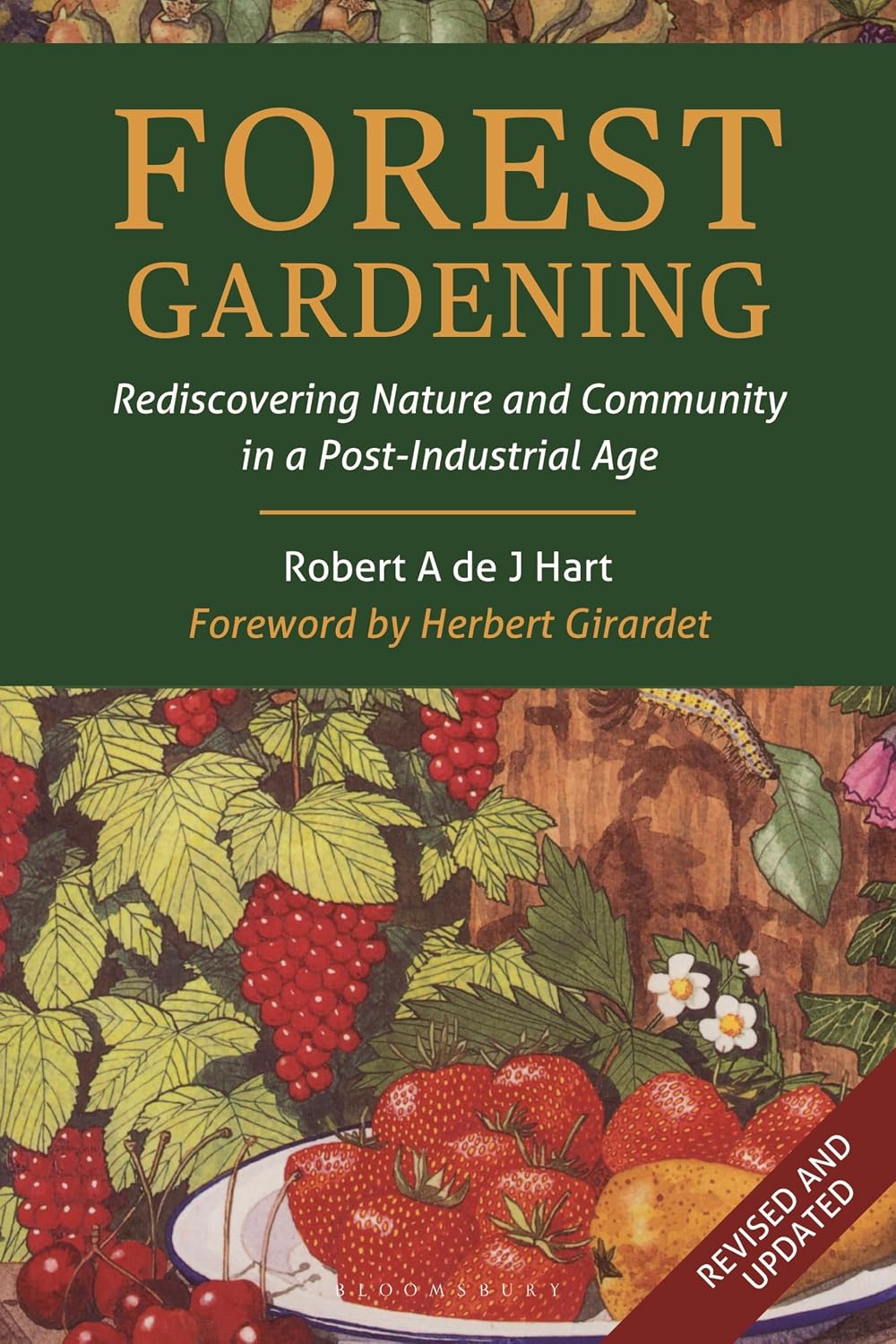
You don’t need a forest for forest gardening. Based on the model of a healthy natural woodland, a forest garden incorporates a wide variety of useful plants, including fruit and nut trees, perennial herbs, and vegetables in vertical layers. They rarely require any weeding, digging or pest control and as plants are chosen for their beneficial effects on one another, they form their own sustainable ecosystems, offering great environmental benefits.
Written by forest gardening pioneer, Robert Hart, this comprehensive guide to forest gardening describes its principles and practice, including guidelines on how to design and maintain a forest garden, and lists of recommended species for temperate, tropical and sub-tropical climates. It also shows potential value of forest gardening for countering environmental devastation.
Hart's book beautifully describes his decades of experience gardening in the Shropshire countryside, and offers fresh ways of understanding the relationships between people and growing plants. Blending history, philosophy, anthropology, and seasoned gardening wisdom in a lucid sequence of essays, Forest Gardening examines the pleasure of 'hands off' as well as hands-on gardening.
For gardeners who aspire to create ecological as well as beautiful gardens, Forest Gardening will be an inspiration and a pleasure.
Review
"Robert Hart's tiny forest garden in Shropshire, covering no more than an eighth of an acre, is quite unlike anything I have seen in Britain or elsewhere in Europe. It is almost tropical in its lushness and fertility, and overflows with an abundant and tantalising variety of things to eat... An inspirational, optimistic book." -- Fiona Anderson, Tree News
About the Author
Excerpt. © Reprinted by permission. All rights reserved.
My mini-forest is the culmination of many years' study and practice of the system that has come to be known as Agroforestry or Permaculture, and which many people, including myself, believe has a major role to play in the evolution of an 'alternative', holistic world order. A Green World. The world of Gaia.
Agroforestry is the generic term for methods of cultivation in which trees are grown in or at the edge of pastureland or in conjunction with crops. The trees are generally regarded as fulfilling multiple functions: conserving the environment, controlling groundwater, providing shade and shelter for livestock, as well as being sources of timber, fuel, fibres, fodder or food for human consumption. Permaculture (which lays special emphasis on a wide diversity of mainly perennial plants and on landscape design), is a comprehensive form of Agroforestry devised in the early 1970s by Bill Mollison of Australia.
Those who are concerned with the full implications of the ecological crisis which we now face generally agree that urgent steps should be taken to plant many millions of trees. In pondering how this could be achieved, I was haunted by the title of a book by the Australian mining engineer, farmer and landscape designer, P.A. Yeomans: The City Forest. It occurred to me that there was no reason why many of the desperately needed new trees should not be fruit-trees planted by the owners of town and surburban gardens, who would gain the bonus of growing nourishing food. If one could persuade 100,000 Londoners to plant just ten fruit-trees each, that would be a million trees - quite a forest! And if tree-planting programmes were pursued in urban areas around the world, a new worldwide City Forest would arise which would go some way towards compensating for the devastation of the tropical Rainforest.
Details:
Visit the Green Books (UK) Store
Forest Gardening
BHD1186
Quantity:
Order today to get by 7-14 business days
Delivery fee of BHD 2. Free for orders above BHD 20.
'%3e%3crect%20x='0.599609'%20width='22.4'%20height='16'%20fill='%230A17A7'/%3e%3cpath%20fill-rule='evenodd'%20clip-rule='evenodd'%20d='M-0.426196%20-1.53223L9.1335%204.91587V-1.06506H14.4668V4.91648L24.0263%20-1.53147L25.2193%200.237148L17.6615%205.33494H23.0002V10.6683H17.6618L25.2187%2015.7655L24.0258%2017.5341L14.4668%2011.0865V17.0683H9.1335V11.0871L-0.425634%2017.5348L-1.61858%2015.7662L5.93947%2010.6683H0.600172V5.33494H5.93977L-1.61914%200.236387L-0.426196%20-1.53223Z'%20fill='white'/%3e%3cpath%20d='M15.5332%205.06615L25.6655%20-1.59961'%20stroke='%23DB1F35'%20stroke-width='0.533333'%20stroke-linecap='round'/%3e%3cpath%20d='M16.6094%2010.9578L25.6924%2017.0801'%20stroke='%23DB1F35'%20stroke-width='0.533333'%20stroke-linecap='round'/%3e%3cpath%20d='M7.00176%205.04727L-2.47266%20-1.33789'%20stroke='%23DB1F35'%20stroke-width='0.533333'%20stroke-linecap='round'/%3e%3cpath%20d='M8.02936%2010.8842L-2.47266%2017.8486'%20stroke='%23DB1F35'%20stroke-width='0.533333'%20stroke-linecap='round'/%3e%3cpath%20fill-rule='evenodd'%20clip-rule='evenodd'%20d='M0.599609%209.6H10.1996V16H13.3996V9.6H22.9996V6.4H13.3996V0H10.1996V6.4H0.599609V9.6Z'%20fill='%23E6273E'/%3e%3c/g%3e%3c/svg%3e) Imported From: United Kingdom
Imported From: United Kingdom
At BOLO, we work hard to ensure the products you receive are new, genuine, and sourced from reputable suppliers.
Every product in the BOLO catalogue is sourced through our Verified Global Supply Network of verified sellers, authorized distributors or directly from the manufacturer.
Each product undergoes thorough inspection and verification at our consolidation and fulfilment centers to ensure it meets our strict authenticity and quality standards before being shipped and delivered to you.
If you ever have concerns regarding the authenticity of a product purchased from us, please contact Bolo Support. We will review your inquiry promptly and, if necessary, provide documentation verifying authenticity or offer a suitable resolution.
Your trust is our top priority, and we are committed to maintaining transparency and integrity in every transaction.
While we strive to display accurate information, variations in packaging, labeling, instructions, or formulation may occasionally occur due to regional differences or supplier updates. For detailed or manufacturer-specific information, please contact the brand directly or reach out to BOLO Support for assistance.
Unless otherwise stated, all prices displayed on the product page include applicable taxes and import duties.
BOLO operates in accordance with the laws and regulations of Bahrain. Any items found to be restricted or prohibited for sale within the Bahrain will be cancelled prior to shipment. We take proactive measures to ensure that only products permitted for sale in Bahrain are listed on our website.
All items are shipped by air, and any products classified as “Dangerous Goods (DG)” under IATA regulations will be removed from the order and cancelled.
All orders are processed manually, and we make every effort to process them promptly once confirmed. Products cancelled due to the above reasons will be permanently removed from listings across the website.
Similar suggestions by Bolo
More from this brand
Similar items from “Wildlife Gardening”
Share with
Or share with link
https://www.bolo.bh/products/K1900322021
Visit the Green Books (UK) Store
Forest Gardening
BHD1186
Quantity:
Order today to get by 7-14 business days
Delivery fee of BHD 2. Free for orders above BHD 20.
Imported From: United Kingdom
At BOLO, we work hard to ensure the products you receive are new, genuine, and sourced from reputable suppliers.
Every product in the BOLO catalogue is sourced through our Verified Global Supply Network of verified sellers, authorized distributors or directly from the manufacturer.
Each product undergoes thorough inspection and verification at our consolidation and fulfilment centers to ensure it meets our strict authenticity and quality standards before being shipped and delivered to you.
If you ever have concerns regarding the authenticity of a product purchased from us, please contact Bolo Support. We will review your inquiry promptly and, if necessary, provide documentation verifying authenticity or offer a suitable resolution.
Your trust is our top priority, and we are committed to maintaining transparency and integrity in every transaction.
While we strive to display accurate information, variations in packaging, labeling, instructions, or formulation may occasionally occur due to regional differences or supplier updates. For detailed or manufacturer-specific information, please contact the brand directly or reach out to BOLO Support for assistance.
Unless otherwise stated, all prices displayed on the product page include applicable taxes and import duties.
BOLO operates in accordance with the laws and regulations of Bahrain. Any items found to be restricted or prohibited for sale within the Bahrain will be cancelled prior to shipment. We take proactive measures to ensure that only products permitted for sale in Bahrain are listed on our website.
All items are shipped by air, and any products classified as “Dangerous Goods (DG)” under IATA regulations will be removed from the order and cancelled.
All orders are processed manually, and we make every effort to process them promptly once confirmed. Products cancelled due to the above reasons will be permanently removed from listings across the website.
Description:
You don’t need a forest for forest gardening. Based on the model of a healthy natural woodland, a forest garden incorporates a wide variety of useful plants, including fruit and nut trees, perennial herbs, and vegetables in vertical layers. They rarely require any weeding, digging or pest control and as plants are chosen for their beneficial effects on one another, they form their own sustainable ecosystems, offering great environmental benefits.
Written by forest gardening pioneer, Robert Hart, this comprehensive guide to forest gardening describes its principles and practice, including guidelines on how to design and maintain a forest garden, and lists of recommended species for temperate, tropical and sub-tropical climates. It also shows potential value of forest gardening for countering environmental devastation.
Hart's book beautifully describes his decades of experience gardening in the Shropshire countryside, and offers fresh ways of understanding the relationships between people and growing plants. Blending history, philosophy, anthropology, and seasoned gardening wisdom in a lucid sequence of essays, Forest Gardening examines the pleasure of 'hands off' as well as hands-on gardening.
For gardeners who aspire to create ecological as well as beautiful gardens, Forest Gardening will be an inspiration and a pleasure.
Review
"Robert Hart's tiny forest garden in Shropshire, covering no more than an eighth of an acre, is quite unlike anything I have seen in Britain or elsewhere in Europe. It is almost tropical in its lushness and fertility, and overflows with an abundant and tantalising variety of things to eat... An inspirational, optimistic book." -- Fiona Anderson, Tree News
About the Author
Excerpt. © Reprinted by permission. All rights reserved.
My mini-forest is the culmination of many years' study and practice of the system that has come to be known as Agroforestry or Permaculture, and which many people, including myself, believe has a major role to play in the evolution of an 'alternative', holistic world order. A Green World. The world of Gaia.
Agroforestry is the generic term for methods of cultivation in which trees are grown in or at the edge of pastureland or in conjunction with crops. The trees are generally regarded as fulfilling multiple functions: conserving the environment, controlling groundwater, providing shade and shelter for livestock, as well as being sources of timber, fuel, fibres, fodder or food for human consumption. Permaculture (which lays special emphasis on a wide diversity of mainly perennial plants and on landscape design), is a comprehensive form of Agroforestry devised in the early 1970s by Bill Mollison of Australia.
Those who are concerned with the full implications of the ecological crisis which we now face generally agree that urgent steps should be taken to plant many millions of trees. In pondering how this could be achieved, I was haunted by the title of a book by the Australian mining engineer, farmer and landscape designer, P.A. Yeomans: The City Forest. It occurred to me that there was no reason why many of the desperately needed new trees should not be fruit-trees planted by the owners of town and surburban gardens, who would gain the bonus of growing nourishing food. If one could persuade 100,000 Londoners to plant just ten fruit-trees each, that would be a million trees - quite a forest! And if tree-planting programmes were pursued in urban areas around the world, a new worldwide City Forest would arise which would go some way towards compensating for the devastation of the tropical Rainforest.
Details:
Similar suggestions by Bolo
More from this brand
Similar items from “Wildlife Gardening”
Share with
Or share with link
https://www.bolo.bh/products/K1900322021