Description:
“Crammed with practical ideas, inspirational images & creative exercises, Conscious Creativity leads the reader through the process of establishing what kind of creative you are...”–Mslexia
“The purpose of this book is to enable you to look at things in an alternative and more substantial way, so that you arrive at composition through genuine interest.”–Juno magazine
“Philippa Stanton is passionate about people connecting to their innate creativity and has distilled these incredible techniques and ideas on how we can tap into that. Philippa is a massively successful Instagramer at @5ftinf and yet she is only too aware how these little two dimensional squares can limit our experiences and restrict our creativity, so it’s not without a little irony that she’s written a book to encourage people to step away from their screens and connect more with the 3D world. It’s a fascinating subject and I wholeheartedly recommend the book for anyone who’s working in the creative industry or is curious about the world around them.”–Sophie Robinson (DIY SOS, The Great British Interior Design Challenge, This Morning)
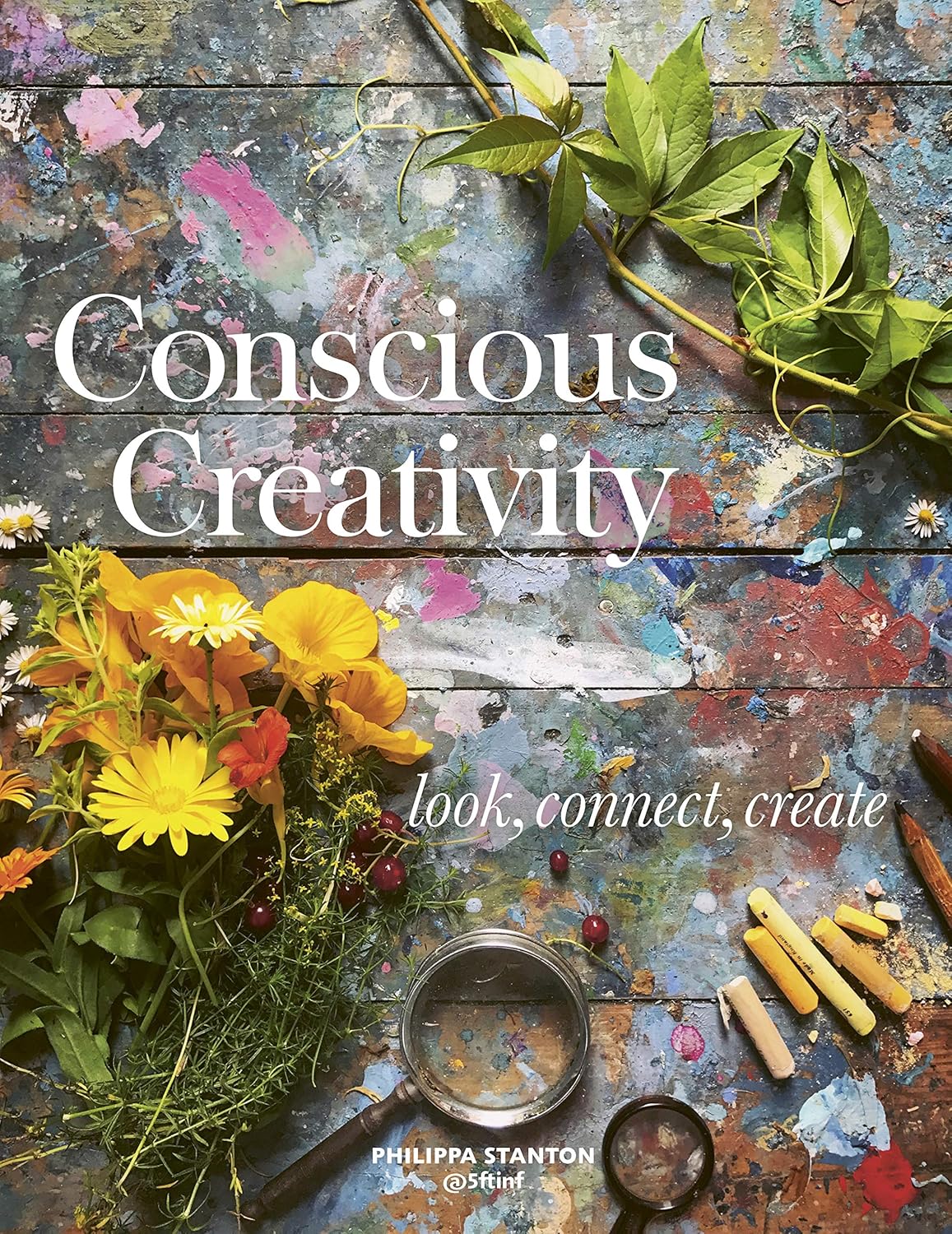
Unlock your creative potential with Conscious Creativity: a practical, playful guide bursting with inspiration to help bring more colour into to your life.
There is creativity in all of us, but it can easily be buried beneath our everyday concerns or need a spark to bring it back to life. Whether you’ve lost your mojo or just need some fresh ideas, artist and photographer Philippa Stanton’s lively guide will stimulate your imagination and reinvigorate your creative life.
Engage your curiosity and connect your observations to your creative practice with activities such as:
- Noticing all the hues of one colour you can see around you
- Creating an abstract textured image using herbs, spices and other dry ingredients from your kitchen cupboards
- Collecting shadows: photograph hidden shapes and dark spaces that you haven’t noticed before
Bursting with practical ideas and inspirational images, embrace the joy of creating, and learn to use your natural curiosity to take a leap into the most creative time of your life.
If you like this, you might also like Creative Flow and Nature Tonic.
Review
― Betty magazine
"This new tome is packed full of mindful craft exercises, tips, stunning imagery and personal accounts. The book aims to help readers to fully appreciate what is around them, opening up their senses to the beauty they may mot notice every day, and showing how to capture it through crafts." ― Your Home
"A creativity guide, prompting visual and visceral experiences, which sit alongside memory and abstract thinking." ― Psychologies
"Sometimes it's easy to fall into a crafty rut, so Philippa Stanton reveals how to get your mojo back, with simple yet beautifully illustrated exercises to help you find inspiration in everything around you." ― Crafts Beautiful
"Crammed with practical ideas, inspirational images & creative exercises, Conscious Creativity leads the reader through the process of establishing what kind of creative you are..." ― Mslexia
"The purpose of this book is to enable you to look at things in an alternative and more substantial way, so that you arrive at composition through genuine interest." ― Juno
“Philippa is passionate about people connecting to their innate creativity and has distilled these incredible techniques and ideas on how we can tap into that.” ― Sophie Robinson Interiors
“Wanting to get a bit more creativity going in your life, but not sure where to start? Philippa Stanton's book, Conscious Creativity, could be just what you need - with daily practices offering specific instructions to get you in touch with your senses.” ― Made for Mums
“A few flicks through Conscious Creativity and you’re sure to get your crafting mojo back in next to no time.” ― Papercrafter
“Packed with joyful wisdom, this fascinating title invites readers to open their eyes to the beauty of ordinary things and connect with their creative impulses.” ― Craft Focus
"A beautiful toolbox of tips, techniques and exercises to ignite your inner creative." ― The Home Page
From the Back Cover
There is creativity in all of us, but it can easily be buried beneath our everyday concerns, or need a spark to bring it back to life. Whether you’ve lost your mojo or just need some fresh ideas, artist and photographer Philippa Stanton’s lively guide will stimulate your imagination and reinvigorate your creative life.
Conscious Creativity will help you fully appreciate what is around you, opening all your senses to the beauty you may not notice every day, and showing you how to capture it. Simple, engaging exercises that encourage observation and experimentation will give you an insight into your own aesthetics as you take a conscious step to note the colours, shapes, shadows, sounds and textures that fill your world and how they make you feel.
Bursting with practical ideas and inspirational images, Conscious Creativity shows you how to unlock your potential, learn to use your natural curiosity and take a leap into the most creative time of your life.
About the Author
Excerpt. © Reprinted by permission. All rights reserved.
Conscious Creativity
Look, Connect, Create
By Philippa StantonThe Quarto Group
Copyright © 2018 Philippa StantonAll rights reserved.
ISBN: 978-1-78240-634-1
Contents
Introduction, 6,1 What Sort of Creative Are You?, 10,
2 Structure, Practice and Obstacles, 20,
3 Looking, 40,
4 Documenting, 52,
5 Texture and Wabi Sabi, 60,
6 Colour, 70,
7 The Senses and Synaesthesia, 86,
8 Atmosphere and Nothing, 106,
9 Light and Shadow, 116,
10 Abstract, 128,
11 Composition, 142,
12 Continuing Practice and Personal Projects, 152,
CHAPTER 1
What Sort of Creative Are You?
Focusing and grounding your initial journey through investigation and instinct
Being creative and curious is a fundamental part of being a human being - we are all hard-wired to invent, explore and experiment - however, before you throw yourself into a frenzy of creative activity, it will be useful first to determine the type of creative you are.
You may feel intimidated by creativity or you may feel that you have it in abundance. You might feel you need to work out how to access your creative potential or you may think that you're not creative at all. You might even feel that all this focus on creativity is a load of nonsense. Working out what type of creative person you are does not mean you're making a decision that is set in stone, but it is something that will help you focus your initial journey.
As babies, creativity is our default setting, and at some point in our early development we will all have used our senses and instincts to survive and learn without the hindrance of intellectual analysis. Babies and toddlers are always exploring, putting everything into their mouths to investigate new textures, tastes and shapes. They develop their communication skills by trying out different sounds and they often discover their own sense of expression by simple mark making - sometimes with a lipstick all over the sofa or a felt-tip pen on a wall.
A baby will grab at a potted plant because it looks interesting and new. If it topples over and spills out they start playing with the soil, eating it, feeling it, pulling the remaining plant apart and sitting proudly in the centre of their efforts. What has been 'created' might seem to be a complete mess, but it's also an innocent and informative investigation. Artists and babies often both share that similar quality of freedom. They express themselves in ways relevant to who they are and how they feel. They make their marks and their sounds because they want to, because they're trying something new and have something they want to say.
Being creative isn't specifically about tuning into your inner child, but this book will encourage you to observe the world around you with a level of interest akin to that of a child. It's about reconnecting with the inquisitiveness, observation and instinct found in infancy, which we often lose sight of as we become adults.
Before embarking on any course of action, it's always useful to question why you're actually doing it, what you'd like to get out of it and how you feel about it. Asking what type of creative person you think you are makes you consider yourself and your abilities and will help you to follow and develop a particular path or completely change it. Question what you think you already know and often your quickest and most instinctive responses will be the most insightful ones. The questions in this chapter are designed to enlighten you in a very simple way, rather than encourage any negative feelings, which can assassinate good ideas, particularly in their nascent stage.
There are no right or wrong answers here, it's just a very simple and personal investigation for you to reflect on and consider, and if more complicated thoughts or questions emerge, it will be interesting to think about those too. It's also useful to actually write your answers down, as a first commitment. Just thinking the answers in your head is an intellectual cop-out.
The type of creative person you view yourself as will probably change and develop over the course of the book, so to ask the question now means that you'll be able to compare your responses at a later stage. And finally, it's important to answer honestly and not in a way that you'd like to be perceived.
Ever since I was a child, I've always had lots of questions, and still do, often to the irritation of family and friends. When I was little our Young People's Encyclopaedia was always quickly exhausted. For example, it couldn't answer 'What is that jelly stuff inside a bubble of seaweed called?' As there was no internet, I'd have to ask my parents and brother all my questions and after a while my mum would often say, 'Actually, I don't know. Shall we go to the library and look it up?' You assume that your parents' knowledge will never run dry, but my mum would not only admit that she didn't know something, she would actively show an interest in discovering an answer.
Not knowing something is a brilliant route to creative discovery and even though nowadays we can look things up quickly online, how we find those answers and what those answers then lead us on to discover is a fascinating wormhole of creativity in itself.
Like any other discipline across the board, creativity is something that needs to be practised and exercised; the more you engage with the practice, the more you will get from it, and you will learn to trust your own way of doing things and your own way of seeing the world. Even if you feel chaotic, underprepared and unproductive at first, experimentation and questioning are never wasted and everyone, at any level, needs to practise. Doing things you don't want to do, or don't like, will often prove far more productive than constantly focusing on the things you find easy. The great thing about creativity is that pushing boundaries is so accessible and solutions are infinite.
We are all drawn to particular aesthetics and we each have feelings about how things should look or be done, even if we don't know why or how to do them ourselves. We all have our preferred colours, fabrics, buildings, interiors, landscapes - all of which personally resonate with us. Most of the time those aesthetic preferences are taken for granted and not picked apart; it's just something we live with and know.
As a synaesthete my relationship to words and numbers also connects to aesthetics. Synaesthesia, which is very basically a merging of the senses (and which you'll discover more about in Chapter 7), opens up a sort of parallel world of inner abstraction. I can attribute moving forms, shapes, textures and colours to my sensory experiences as well as other concepts like maths and musical notation. For me the number '2' is a sort of golden yellow colour. '7' is also yellow, but a lighter shade with a bit of white inside and a bright sort of glowing edge.
All my numerical colours are important to me, although as my mathematical father regularly pointed out, have absolutely no relevance to any answers. I was never good at maths. I was far too interested in the shapes and colours of the questions. My processing never seems to be logical; it's long-winded and overly colourful. But I've worked out over the years that this is basically who I am, and I have to live and work with that rather than trying to change it.
I would argue that taking time to consider our personal aesthetic preferences is key to grounding ourselves creatively. Knowing what your likes and dislikes are, along with your strengths and weaknesses, is a really safe base from which you can explore and dare yourself to experiment.
CHAPTER 2Structure, Practice and Obstacles
Ways of working to give you a sense of aspiration and achievability
When I was about eight I started piano lessons. I'd watched people skilfully playing old familiar tunes and effortlessly entertaining at parties and I wanted to be able to do the same. It looked fun, and piano lessons also meant that I got out of a maths class every Thursday. I initially felt motivated, but it quickly became apparent that I had no natural talent and was totally incapable of any kind of practice. Rather shamefully, learning to play the piano bored me.
My mind would wander; middle C was a beautiful green, A flat a rusty, textured red and F was sort of hollow light blue.
Perhaps if music had been written in colour I would have been more interested in working out how to play. However, my boredom and my wandering mind actually turned out to be the very things that pulled my creativity into focus.
This chapter is about encouraging structure and developing new creative habits to help your creative practice, but first I want to look at some of the obstacles that can often hinder new beginnings.
Chapter 1 will have given you a good idea, or outline at least, of your approach and the type of person you are, so this chapter will aim to steer you towards a non-pressured way of working that can help give you a productive anchor.
Working with a structure in place, even if it's just this book, can create a sense of security as well as a sense of achievability. Rather than a solution, a structure for your creativity should be regarded as a personal aid, something you can let go of, reinvent and revisit time and time again if you want to. Even a very simple plan is a reassuring point of reference, guiding you through mental clutter, acting as a great springboard and becoming a stimulus for creating new work. In the long term, it will actually be the departure from the structure that will lead to a deeper development of your own creative practice. The time will come when you allow yourself to veer off plan, step away from your safe zone and totally engage with your burgeoning curiosity.
Personally, I like to have visual structures in place; I need to see things in front of me, constant reminders to stay on track and do things, and they usually appear in the shape of a handwritten list and sticky notes. I've always been a massive list writer and they can vary enormously, spanning 'beautiful places I must see' and 'painting project ideas' to 'domestic appliances that need to be fixed'. But I always spend time thinking about how I need the list to look, what its purpose is and how motivational I need it to be. Sometimes I even design them specifically to appear loud.
There is no definitive way to create your personal working structure as everyone is so different; I work in quite a chaotic, childlike way, for example, even though my fantasy version of me works in a calm, minimalist way. You might be someone who works best with neat and tidy order, but with a fantasy about the excitement of allowing some chaos into your life. Whichever way you lean, allow yourself to lean that way, but always keep your fantasy or ideal on your shoulder. Your structure or plan should contain both aspiration and achievability, and I will help prompt you in directions that feel comfortable, fun and not remotely intimidating.
The purpose of the first 20 questions in the previous chapter is to try and help you gain a bit of personal insight. For example, there is nothing necessarily wrong with procrastination, and in fact it is part of the whole creative process, but feeling guilty about it will only serve to assassinate fermenting creative ideas. Obviously there will always need to be a cut-off point when you actually dare yourself to do something, but there is actually a lot to be gained from time spent cleaning the cooker. Conversely, if you are always leaping straight into doing, you may need to develop the ability to procrastinate and slow down time.
The internet may be able to keep on giving us more and more 'stuff' ad infinitum, but our brains don't function like that. Our brains function in a much slower way, and connecting to our creative side involves inhabiting time in a capacity that is at odds with our standard perception of how we think it flows.
The second 20 questions are designed more towards engagement with creative and enjoyable stimuli; helping you to recognize places that make you feel comfortable, activities you enjoy and things you like looking at. All of these elements should play into your structure of practice, as practice is about absorbing inspiration and information as much as any actual 'doing'.
My singing teacher at RADA rarely told me to practise, but he did encourage me to listen to music I was unfamiliar with. At the end of my first summer term he told me I should listen to Maria Callas, who at that point I had never heard of, singing 'Una Voce Poco Fa'. I got the music from my local library and spent the whole summer singing along to a tape in my 2CV on my way to work. When I arrived back to class in September, I could reach top C. I had no idea that I could sing and it became so exciting that I would get to college at 8:30am every morning just to practise. My teacher had not only seen my potential, but had also acknowledged that I needed to take inspiration from somewhere or something. The structure that had been the springboard to a commitment to practise had simply been listening to unfamiliar music along with a gentle prompt and genuine encouragement. It can be as simple as that.
Time
Time holds a very particular place in creative practice. When you're working on a project it often feels like one moment you've just had breakfast and the next moment you need to make supper. Time loses significance in the act of doing. Hours can feel like minutes in a burst of productivity, yet minutes can feel like hours in times of defeat. Time goes too quickly with an old friend and too slowly with an old bore.
Time is something we all have to adhere to, but which is impossible to actually observe. We are only able to observe time in the context of space and things, nature and growth, and it's important to ascertain your own relationship to time. Whether you enjoy being totally immersed in an activity without interruption or if you have a tendency to be more time-specific, it is crucial in both cases to allow yourself periods free from the standard constructs of time. For some it will be space to work freely and comfortably, and for others it will be an exercise in letting go of any guilt felt about time spent alone just to do something you love. Allowing yourself to become part of time and space with a simple, enjoyable, solitary activity can feel luxurious, but these time slips are definitely something to be encouraged and they always leave you with a sense of pride that you have been totally engaged in an activity. Rather than the world passing you by, in these periods, the world comes to you.
Boredom
Boredom is an integral factor in the creative process and one not to be ignored. Our minds are regularly tied up, often on our devices, and as constant stimulation leaves no space for idle thought, who knows whether some of our greatest ideas have already been pushed aside while we were gaming or checking social media?
The German word for boredom is 'langeweile' meaning 'long while', which seems very appropriate, as boredom is essentially about nothing other than our interaction with time passing. However, boredom provides the exact nothingness in time that allows our minds to wander and invent. Unlike meditation, where you concentrate on keeping your mind focused and away from escape, boredom concentrates on seeking the most creative exit. Various synonyms for boredom include: weariness, lack of enthusiasm, lack of interest, apathy, sluggishness, frustration, languor, dissatisfaction, restlessness, tediousness, dullness, monotony, repetitiveness, flatness, blandness, sameness, routine and dreariness, and I can honestly say that I have felt all of these things during the creative process, particularly when I'm working on a painting.
Apparently the scientist Galileo was bored during a religious service in Pisa. He started to measure the duration of the oscillations of the cathedral's giant chandelier by counting the beats of his pulse. By letting his mind wander, he had discovered a way to measure time.
Once you acknowledge that boredom can play a meaningful part in your creative journey, the most tedious of jobs - like washing up, cleaning or queuing - will show you that they nurture motivation and some of your best creative sparks.
It may seem counterintuitive to set yourself the task of being bored, but I suppose it's actually more about finding those moments that allow the boredom through. A lot of those moments exist in periods of waiting - time spent in a sort of limbo before something happens. Whether you're waiting for a bus, in a doctor's waiting room, in a traffic jam or outside the school gates, it's these boring times that make you reach for your phone. The task is to resist your device, focus on your boredom and engage your senses.
Comparison assassination
There is a lot written about comparison at the moment, as it is becoming increasingly obvious that social media is a powerful engine fuelling negative comparison and low self-esteem. We find ways to evaluate ourselves through comparison, but we don't usually come out on top. Comparison has always been around, but it currently seems almost impossible to avoid. Social media feeds us with what is most detrimental to our personal accomplishments and values, gaining influence with our addictive consumption of it. Looking at other people's lives and work can be incredibly inspirational, but we have to be in the right frame of mind to take it that way.
The Dutch have a word 'benijden' meaning 'benign envy'. It refers to an envy that motivates you to self-improvement deriving from another person's impressive example. This is a positive take on envy, but it's easier said than done. Everything screams at you not to compare yourself to others but, quite frankly, it's inescapable and can very quickly lead to an awful creative atrophy.
(Continues...)Excerpted from Conscious Creativity by Philippa Stanton. Copyright © 2018 Philippa Stanton. Excerpted by permission of The Quarto Group.
All rights reserved. No part of this excerpt may be reproduced or reprinted without permission in writing from the publisher.
Excerpts are provided by Dial-A-Book Inc. solely for the personal use of visitors to this web site.
Details:
Visit the Philippa Stanton (Author) Store
Conscious Creativity: Look, Connect, Create
BHD1219
Quantity:
Order today to get by 7-14 business days
Delivery fee of BHD 2. Free for orders above BHD 20.
'%3e%3crect%20x='0.599609'%20width='22.4'%20height='16'%20fill='%230A17A7'/%3e%3cpath%20fill-rule='evenodd'%20clip-rule='evenodd'%20d='M-0.426196%20-1.53223L9.1335%204.91587V-1.06506H14.4668V4.91648L24.0263%20-1.53147L25.2193%200.237148L17.6615%205.33494H23.0002V10.6683H17.6618L25.2187%2015.7655L24.0258%2017.5341L14.4668%2011.0865V17.0683H9.1335V11.0871L-0.425634%2017.5348L-1.61858%2015.7662L5.93947%2010.6683H0.600172V5.33494H5.93977L-1.61914%200.236387L-0.426196%20-1.53223Z'%20fill='white'/%3e%3cpath%20d='M15.5332%205.06615L25.6655%20-1.59961'%20stroke='%23DB1F35'%20stroke-width='0.533333'%20stroke-linecap='round'/%3e%3cpath%20d='M16.6094%2010.9578L25.6924%2017.0801'%20stroke='%23DB1F35'%20stroke-width='0.533333'%20stroke-linecap='round'/%3e%3cpath%20d='M7.00176%205.04727L-2.47266%20-1.33789'%20stroke='%23DB1F35'%20stroke-width='0.533333'%20stroke-linecap='round'/%3e%3cpath%20d='M8.02936%2010.8842L-2.47266%2017.8486'%20stroke='%23DB1F35'%20stroke-width='0.533333'%20stroke-linecap='round'/%3e%3cpath%20fill-rule='evenodd'%20clip-rule='evenodd'%20d='M0.599609%209.6H10.1996V16H13.3996V9.6H22.9996V6.4H13.3996V0H10.1996V6.4H0.599609V9.6Z'%20fill='%23E6273E'/%3e%3c/g%3e%3c/svg%3e) Imported From: United Kingdom
Imported From: United Kingdom
At BOLO, we work hard to ensure the products you receive are new, genuine, and sourced from reputable suppliers.
Every product in the BOLO catalogue is sourced through our Verified Global Supply Network of verified sellers, authorized distributors or directly from the manufacturer.
Each product undergoes thorough inspection and verification at our consolidation and fulfilment centers to ensure it meets our strict authenticity and quality standards before being shipped and delivered to you.
If you ever have concerns regarding the authenticity of a product purchased from us, please contact Bolo Support. We will review your inquiry promptly and, if necessary, provide documentation verifying authenticity or offer a suitable resolution.
Your trust is our top priority, and we are committed to maintaining transparency and integrity in every transaction.
While we strive to display accurate information, variations in packaging, labeling, instructions, or formulation may occasionally occur due to regional differences or supplier updates. For detailed or manufacturer-specific information, please contact the brand directly or reach out to BOLO Support for assistance.
Unless otherwise stated, all prices displayed on the product page include applicable taxes and import duties.
BOLO operates in accordance with the laws and regulations of Bahrain. Any items found to be restricted or prohibited for sale within the Bahrain will be cancelled prior to shipment. We take proactive measures to ensure that only products permitted for sale in Bahrain are listed on our website.
All items are shipped by air, and any products classified as “Dangerous Goods (DG)” under IATA regulations will be removed from the order and cancelled.
All orders are processed manually, and we make every effort to process them promptly once confirmed. Products cancelled due to the above reasons will be permanently removed from listings across the website.
Similar suggestions by Bolo
Share with
Or share with link
https://www.bolo.bh/products/K1782406344
Visit the Philippa Stanton (Author) Store
Conscious Creativity: Look, Connect, Create
BHD1219
Quantity:
Order today to get by 7-14 business days
Delivery fee of BHD 2. Free for orders above BHD 20.
Imported From: United Kingdom
At BOLO, we work hard to ensure the products you receive are new, genuine, and sourced from reputable suppliers.
Every product in the BOLO catalogue is sourced through our Verified Global Supply Network of verified sellers, authorized distributors or directly from the manufacturer.
Each product undergoes thorough inspection and verification at our consolidation and fulfilment centers to ensure it meets our strict authenticity and quality standards before being shipped and delivered to you.
If you ever have concerns regarding the authenticity of a product purchased from us, please contact Bolo Support. We will review your inquiry promptly and, if necessary, provide documentation verifying authenticity or offer a suitable resolution.
Your trust is our top priority, and we are committed to maintaining transparency and integrity in every transaction.
While we strive to display accurate information, variations in packaging, labeling, instructions, or formulation may occasionally occur due to regional differences or supplier updates. For detailed or manufacturer-specific information, please contact the brand directly or reach out to BOLO Support for assistance.
Unless otherwise stated, all prices displayed on the product page include applicable taxes and import duties.
BOLO operates in accordance with the laws and regulations of Bahrain. Any items found to be restricted or prohibited for sale within the Bahrain will be cancelled prior to shipment. We take proactive measures to ensure that only products permitted for sale in Bahrain are listed on our website.
All items are shipped by air, and any products classified as “Dangerous Goods (DG)” under IATA regulations will be removed from the order and cancelled.
All orders are processed manually, and we make every effort to process them promptly once confirmed. Products cancelled due to the above reasons will be permanently removed from listings across the website.
Description:
“Crammed with practical ideas, inspirational images & creative exercises, Conscious Creativity leads the reader through the process of establishing what kind of creative you are...”–Mslexia
“The purpose of this book is to enable you to look at things in an alternative and more substantial way, so that you arrive at composition through genuine interest.”–Juno magazine
“Philippa Stanton is passionate about people connecting to their innate creativity and has distilled these incredible techniques and ideas on how we can tap into that. Philippa is a massively successful Instagramer at @5ftinf and yet she is only too aware how these little two dimensional squares can limit our experiences and restrict our creativity, so it’s not without a little irony that she’s written a book to encourage people to step away from their screens and connect more with the 3D world. It’s a fascinating subject and I wholeheartedly recommend the book for anyone who’s working in the creative industry or is curious about the world around them.”–Sophie Robinson (DIY SOS, The Great British Interior Design Challenge, This Morning)
Unlock your creative potential with Conscious Creativity: a practical, playful guide bursting with inspiration to help bring more colour into to your life.
There is creativity in all of us, but it can easily be buried beneath our everyday concerns or need a spark to bring it back to life. Whether you’ve lost your mojo or just need some fresh ideas, artist and photographer Philippa Stanton’s lively guide will stimulate your imagination and reinvigorate your creative life.
Engage your curiosity and connect your observations to your creative practice with activities such as:
- Noticing all the hues of one colour you can see around you
- Creating an abstract textured image using herbs, spices and other dry ingredients from your kitchen cupboards
- Collecting shadows: photograph hidden shapes and dark spaces that you haven’t noticed before
Bursting with practical ideas and inspirational images, embrace the joy of creating, and learn to use your natural curiosity to take a leap into the most creative time of your life.
If you like this, you might also like Creative Flow and Nature Tonic.
Review
― Betty magazine
"This new tome is packed full of mindful craft exercises, tips, stunning imagery and personal accounts. The book aims to help readers to fully appreciate what is around them, opening up their senses to the beauty they may mot notice every day, and showing how to capture it through crafts." ― Your Home
"A creativity guide, prompting visual and visceral experiences, which sit alongside memory and abstract thinking." ― Psychologies
"Sometimes it's easy to fall into a crafty rut, so Philippa Stanton reveals how to get your mojo back, with simple yet beautifully illustrated exercises to help you find inspiration in everything around you." ― Crafts Beautiful
"Crammed with practical ideas, inspirational images & creative exercises, Conscious Creativity leads the reader through the process of establishing what kind of creative you are..." ― Mslexia
"The purpose of this book is to enable you to look at things in an alternative and more substantial way, so that you arrive at composition through genuine interest." ― Juno
“Philippa is passionate about people connecting to their innate creativity and has distilled these incredible techniques and ideas on how we can tap into that.” ― Sophie Robinson Interiors
“Wanting to get a bit more creativity going in your life, but not sure where to start? Philippa Stanton's book, Conscious Creativity, could be just what you need - with daily practices offering specific instructions to get you in touch with your senses.” ― Made for Mums
“A few flicks through Conscious Creativity and you’re sure to get your crafting mojo back in next to no time.” ― Papercrafter
“Packed with joyful wisdom, this fascinating title invites readers to open their eyes to the beauty of ordinary things and connect with their creative impulses.” ― Craft Focus
"A beautiful toolbox of tips, techniques and exercises to ignite your inner creative." ― The Home Page
From the Back Cover
There is creativity in all of us, but it can easily be buried beneath our everyday concerns, or need a spark to bring it back to life. Whether you’ve lost your mojo or just need some fresh ideas, artist and photographer Philippa Stanton’s lively guide will stimulate your imagination and reinvigorate your creative life.
Conscious Creativity will help you fully appreciate what is around you, opening all your senses to the beauty you may not notice every day, and showing you how to capture it. Simple, engaging exercises that encourage observation and experimentation will give you an insight into your own aesthetics as you take a conscious step to note the colours, shapes, shadows, sounds and textures that fill your world and how they make you feel.
Bursting with practical ideas and inspirational images, Conscious Creativity shows you how to unlock your potential, learn to use your natural curiosity and take a leap into the most creative time of your life.
About the Author
Excerpt. © Reprinted by permission. All rights reserved.
Conscious Creativity
Look, Connect, Create
By Philippa StantonThe Quarto Group
Copyright © 2018 Philippa StantonAll rights reserved.
ISBN: 978-1-78240-634-1
Contents
Introduction, 6,1 What Sort of Creative Are You?, 10,
2 Structure, Practice and Obstacles, 20,
3 Looking, 40,
4 Documenting, 52,
5 Texture and Wabi Sabi, 60,
6 Colour, 70,
7 The Senses and Synaesthesia, 86,
8 Atmosphere and Nothing, 106,
9 Light and Shadow, 116,
10 Abstract, 128,
11 Composition, 142,
12 Continuing Practice and Personal Projects, 152,
CHAPTER 1
What Sort of Creative Are You?
Focusing and grounding your initial journey through investigation and instinct
Being creative and curious is a fundamental part of being a human being - we are all hard-wired to invent, explore and experiment - however, before you throw yourself into a frenzy of creative activity, it will be useful first to determine the type of creative you are.
You may feel intimidated by creativity or you may feel that you have it in abundance. You might feel you need to work out how to access your creative potential or you may think that you're not creative at all. You might even feel that all this focus on creativity is a load of nonsense. Working out what type of creative person you are does not mean you're making a decision that is set in stone, but it is something that will help you focus your initial journey.
As babies, creativity is our default setting, and at some point in our early development we will all have used our senses and instincts to survive and learn without the hindrance of intellectual analysis. Babies and toddlers are always exploring, putting everything into their mouths to investigate new textures, tastes and shapes. They develop their communication skills by trying out different sounds and they often discover their own sense of expression by simple mark making - sometimes with a lipstick all over the sofa or a felt-tip pen on a wall.
A baby will grab at a potted plant because it looks interesting and new. If it topples over and spills out they start playing with the soil, eating it, feeling it, pulling the remaining plant apart and sitting proudly in the centre of their efforts. What has been 'created' might seem to be a complete mess, but it's also an innocent and informative investigation. Artists and babies often both share that similar quality of freedom. They express themselves in ways relevant to who they are and how they feel. They make their marks and their sounds because they want to, because they're trying something new and have something they want to say.
Being creative isn't specifically about tuning into your inner child, but this book will encourage you to observe the world around you with a level of interest akin to that of a child. It's about reconnecting with the inquisitiveness, observation and instinct found in infancy, which we often lose sight of as we become adults.
Before embarking on any course of action, it's always useful to question why you're actually doing it, what you'd like to get out of it and how you feel about it. Asking what type of creative person you think you are makes you consider yourself and your abilities and will help you to follow and develop a particular path or completely change it. Question what you think you already know and often your quickest and most instinctive responses will be the most insightful ones. The questions in this chapter are designed to enlighten you in a very simple way, rather than encourage any negative feelings, which can assassinate good ideas, particularly in their nascent stage.
There are no right or wrong answers here, it's just a very simple and personal investigation for you to reflect on and consider, and if more complicated thoughts or questions emerge, it will be interesting to think about those too. It's also useful to actually write your answers down, as a first commitment. Just thinking the answers in your head is an intellectual cop-out.
The type of creative person you view yourself as will probably change and develop over the course of the book, so to ask the question now means that you'll be able to compare your responses at a later stage. And finally, it's important to answer honestly and not in a way that you'd like to be perceived.
Ever since I was a child, I've always had lots of questions, and still do, often to the irritation of family and friends. When I was little our Young People's Encyclopaedia was always quickly exhausted. For example, it couldn't answer 'What is that jelly stuff inside a bubble of seaweed called?' As there was no internet, I'd have to ask my parents and brother all my questions and after a while my mum would often say, 'Actually, I don't know. Shall we go to the library and look it up?' You assume that your parents' knowledge will never run dry, but my mum would not only admit that she didn't know something, she would actively show an interest in discovering an answer.
Not knowing something is a brilliant route to creative discovery and even though nowadays we can look things up quickly online, how we find those answers and what those answers then lead us on to discover is a fascinating wormhole of creativity in itself.
Like any other discipline across the board, creativity is something that needs to be practised and exercised; the more you engage with the practice, the more you will get from it, and you will learn to trust your own way of doing things and your own way of seeing the world. Even if you feel chaotic, underprepared and unproductive at first, experimentation and questioning are never wasted and everyone, at any level, needs to practise. Doing things you don't want to do, or don't like, will often prove far more productive than constantly focusing on the things you find easy. The great thing about creativity is that pushing boundaries is so accessible and solutions are infinite.
We are all drawn to particular aesthetics and we each have feelings about how things should look or be done, even if we don't know why or how to do them ourselves. We all have our preferred colours, fabrics, buildings, interiors, landscapes - all of which personally resonate with us. Most of the time those aesthetic preferences are taken for granted and not picked apart; it's just something we live with and know.
As a synaesthete my relationship to words and numbers also connects to aesthetics. Synaesthesia, which is very basically a merging of the senses (and which you'll discover more about in Chapter 7), opens up a sort of parallel world of inner abstraction. I can attribute moving forms, shapes, textures and colours to my sensory experiences as well as other concepts like maths and musical notation. For me the number '2' is a sort of golden yellow colour. '7' is also yellow, but a lighter shade with a bit of white inside and a bright sort of glowing edge.
All my numerical colours are important to me, although as my mathematical father regularly pointed out, have absolutely no relevance to any answers. I was never good at maths. I was far too interested in the shapes and colours of the questions. My processing never seems to be logical; it's long-winded and overly colourful. But I've worked out over the years that this is basically who I am, and I have to live and work with that rather than trying to change it.
I would argue that taking time to consider our personal aesthetic preferences is key to grounding ourselves creatively. Knowing what your likes and dislikes are, along with your strengths and weaknesses, is a really safe base from which you can explore and dare yourself to experiment.
CHAPTER 2Structure, Practice and Obstacles
Ways of working to give you a sense of aspiration and achievability
When I was about eight I started piano lessons. I'd watched people skilfully playing old familiar tunes and effortlessly entertaining at parties and I wanted to be able to do the same. It looked fun, and piano lessons also meant that I got out of a maths class every Thursday. I initially felt motivated, but it quickly became apparent that I had no natural talent and was totally incapable of any kind of practice. Rather shamefully, learning to play the piano bored me.
My mind would wander; middle C was a beautiful green, A flat a rusty, textured red and F was sort of hollow light blue.
Perhaps if music had been written in colour I would have been more interested in working out how to play. However, my boredom and my wandering mind actually turned out to be the very things that pulled my creativity into focus.
This chapter is about encouraging structure and developing new creative habits to help your creative practice, but first I want to look at some of the obstacles that can often hinder new beginnings.
Chapter 1 will have given you a good idea, or outline at least, of your approach and the type of person you are, so this chapter will aim to steer you towards a non-pressured way of working that can help give you a productive anchor.
Working with a structure in place, even if it's just this book, can create a sense of security as well as a sense of achievability. Rather than a solution, a structure for your creativity should be regarded as a personal aid, something you can let go of, reinvent and revisit time and time again if you want to. Even a very simple plan is a reassuring point of reference, guiding you through mental clutter, acting as a great springboard and becoming a stimulus for creating new work. In the long term, it will actually be the departure from the structure that will lead to a deeper development of your own creative practice. The time will come when you allow yourself to veer off plan, step away from your safe zone and totally engage with your burgeoning curiosity.
Personally, I like to have visual structures in place; I need to see things in front of me, constant reminders to stay on track and do things, and they usually appear in the shape of a handwritten list and sticky notes. I've always been a massive list writer and they can vary enormously, spanning 'beautiful places I must see' and 'painting project ideas' to 'domestic appliances that need to be fixed'. But I always spend time thinking about how I need the list to look, what its purpose is and how motivational I need it to be. Sometimes I even design them specifically to appear loud.
There is no definitive way to create your personal working structure as everyone is so different; I work in quite a chaotic, childlike way, for example, even though my fantasy version of me works in a calm, minimalist way. You might be someone who works best with neat and tidy order, but with a fantasy about the excitement of allowing some chaos into your life. Whichever way you lean, allow yourself to lean that way, but always keep your fantasy or ideal on your shoulder. Your structure or plan should contain both aspiration and achievability, and I will help prompt you in directions that feel comfortable, fun and not remotely intimidating.
The purpose of the first 20 questions in the previous chapter is to try and help you gain a bit of personal insight. For example, there is nothing necessarily wrong with procrastination, and in fact it is part of the whole creative process, but feeling guilty about it will only serve to assassinate fermenting creative ideas. Obviously there will always need to be a cut-off point when you actually dare yourself to do something, but there is actually a lot to be gained from time spent cleaning the cooker. Conversely, if you are always leaping straight into doing, you may need to develop the ability to procrastinate and slow down time.
The internet may be able to keep on giving us more and more 'stuff' ad infinitum, but our brains don't function like that. Our brains function in a much slower way, and connecting to our creative side involves inhabiting time in a capacity that is at odds with our standard perception of how we think it flows.
The second 20 questions are designed more towards engagement with creative and enjoyable stimuli; helping you to recognize places that make you feel comfortable, activities you enjoy and things you like looking at. All of these elements should play into your structure of practice, as practice is about absorbing inspiration and information as much as any actual 'doing'.
My singing teacher at RADA rarely told me to practise, but he did encourage me to listen to music I was unfamiliar with. At the end of my first summer term he told me I should listen to Maria Callas, who at that point I had never heard of, singing 'Una Voce Poco Fa'. I got the music from my local library and spent the whole summer singing along to a tape in my 2CV on my way to work. When I arrived back to class in September, I could reach top C. I had no idea that I could sing and it became so exciting that I would get to college at 8:30am every morning just to practise. My teacher had not only seen my potential, but had also acknowledged that I needed to take inspiration from somewhere or something. The structure that had been the springboard to a commitment to practise had simply been listening to unfamiliar music along with a gentle prompt and genuine encouragement. It can be as simple as that.
Time
Time holds a very particular place in creative practice. When you're working on a project it often feels like one moment you've just had breakfast and the next moment you need to make supper. Time loses significance in the act of doing. Hours can feel like minutes in a burst of productivity, yet minutes can feel like hours in times of defeat. Time goes too quickly with an old friend and too slowly with an old bore.
Time is something we all have to adhere to, but which is impossible to actually observe. We are only able to observe time in the context of space and things, nature and growth, and it's important to ascertain your own relationship to time. Whether you enjoy being totally immersed in an activity without interruption or if you have a tendency to be more time-specific, it is crucial in both cases to allow yourself periods free from the standard constructs of time. For some it will be space to work freely and comfortably, and for others it will be an exercise in letting go of any guilt felt about time spent alone just to do something you love. Allowing yourself to become part of time and space with a simple, enjoyable, solitary activity can feel luxurious, but these time slips are definitely something to be encouraged and they always leave you with a sense of pride that you have been totally engaged in an activity. Rather than the world passing you by, in these periods, the world comes to you.
Boredom
Boredom is an integral factor in the creative process and one not to be ignored. Our minds are regularly tied up, often on our devices, and as constant stimulation leaves no space for idle thought, who knows whether some of our greatest ideas have already been pushed aside while we were gaming or checking social media?
The German word for boredom is 'langeweile' meaning 'long while', which seems very appropriate, as boredom is essentially about nothing other than our interaction with time passing. However, boredom provides the exact nothingness in time that allows our minds to wander and invent. Unlike meditation, where you concentrate on keeping your mind focused and away from escape, boredom concentrates on seeking the most creative exit. Various synonyms for boredom include: weariness, lack of enthusiasm, lack of interest, apathy, sluggishness, frustration, languor, dissatisfaction, restlessness, tediousness, dullness, monotony, repetitiveness, flatness, blandness, sameness, routine and dreariness, and I can honestly say that I have felt all of these things during the creative process, particularly when I'm working on a painting.
Apparently the scientist Galileo was bored during a religious service in Pisa. He started to measure the duration of the oscillations of the cathedral's giant chandelier by counting the beats of his pulse. By letting his mind wander, he had discovered a way to measure time.
Once you acknowledge that boredom can play a meaningful part in your creative journey, the most tedious of jobs - like washing up, cleaning or queuing - will show you that they nurture motivation and some of your best creative sparks.
It may seem counterintuitive to set yourself the task of being bored, but I suppose it's actually more about finding those moments that allow the boredom through. A lot of those moments exist in periods of waiting - time spent in a sort of limbo before something happens. Whether you're waiting for a bus, in a doctor's waiting room, in a traffic jam or outside the school gates, it's these boring times that make you reach for your phone. The task is to resist your device, focus on your boredom and engage your senses.
Comparison assassination
There is a lot written about comparison at the moment, as it is becoming increasingly obvious that social media is a powerful engine fuelling negative comparison and low self-esteem. We find ways to evaluate ourselves through comparison, but we don't usually come out on top. Comparison has always been around, but it currently seems almost impossible to avoid. Social media feeds us with what is most detrimental to our personal accomplishments and values, gaining influence with our addictive consumption of it. Looking at other people's lives and work can be incredibly inspirational, but we have to be in the right frame of mind to take it that way.
The Dutch have a word 'benijden' meaning 'benign envy'. It refers to an envy that motivates you to self-improvement deriving from another person's impressive example. This is a positive take on envy, but it's easier said than done. Everything screams at you not to compare yourself to others but, quite frankly, it's inescapable and can very quickly lead to an awful creative atrophy.
(Continues...)Excerpted from Conscious Creativity by Philippa Stanton. Copyright © 2018 Philippa Stanton. Excerpted by permission of The Quarto Group.
All rights reserved. No part of this excerpt may be reproduced or reprinted without permission in writing from the publisher.
Excerpts are provided by Dial-A-Book Inc. solely for the personal use of visitors to this web site.
Details:
Similar suggestions by Bolo
Share with
Or share with link
https://www.bolo.bh/products/K1782406344